How to Market Your Business Successfully (Without Burning Out)
No more throwing marketing spaghetti at the wall! Or disappearing after a promotional spree. Here’s how to market your business online strategically.

You’re excellent at delivering your services, but when it comes to marketing your business online? Eeeeeeeeeek!
Do you find yourself jumping from one strategy to the next, throwing marketing spaghetti at the wall and praying that something sticks? Still relying on unpredictable referrals and time-consuming outreach?
YOU shouldn’t be the one doing all the heavy-lifting! Your marketing should actively work for you and bring you results. Regularly.
So, I’ll show you how to market your business online in a way that actually works for you.
Because it’s NOT about going on marketing sprees, getting overwhelmed, disappearing, and doing it again (and again).
You must be BOTH strategic and realistic when you market your business online. Here’s how!
Setting the right expectations when marketing your business online

Most of my clients are women solopreneurs and founders of service-based businesses. And even though they work across all kinds of industries? I’ve encountered the same mistakes so far.
Maybe you’re still holding on to outdated marketing misconceptions. Perhaps you’ve been putting too much pressure on yourself—even though you’re just one person.
You see, I really want you to go into this with the right mindset and expectations. So, I’ll start by giving you the same tips I share with most of my clients.
You must market your business online consistently, NOT just when you need new clients
SO many business owners make this mistake.
They go all in with their marketing. Super pumped up! Two coffees and three Red Bulls in. They start posting on social media every day, sending a weekly newsletter, offering all kinds of free webinars…
But then, as soon as they’re fully booked? POOF! They disappear.
And then guess what?
Months later, once they actually need new clients, they reappear as if nothing had happened.
That’s NOT how marketing works, especially if you want to rely on organic and inbound strategies (= getting your dream clients to come to YOU). Instead, you must be consistent and stay top of mind with your audience.
So, get in the mindset and habit of marketing your business regularly, EVEN when you’re fully booked and can’t take on new clients.
But don’t worry: you can do this at your OWN pace
Learning how to market your business online consistently doesn’t have to mean “posting on social media every day, jumping on every new trend, and hustling 24/7.”
In fact, that could actually backfire!
If you force yourself to stick to a schedule that doesn’t work for you? You could easily end up being busy and churning out content just for the sake of it. And that WON’T move the needle.
So, remember:
when marketing your business online? Quality, consistency, and an actual strategy > quantity.
Find the right balance: not too little, not too much
I have two main tips (and it might sound like I’m contradicting myself, but bear with me):
Don’t put all your marketing eggs in one basket – Some business owners seem to think that being on Instagram (or LinkedIn, or just having a website…) is enough to call it ‘marketing.’ Sorry to burst your bubble, but that ain’t gonna cut it. For example, what happens if the algorithm changes or you lose your account?
Don’t spread yourself too thin – At the same time, you don’t have to be on every single platform, jump on every new trend, or have dozens of marketing tactics in place. You’d burn out! And you wouldn’t get the best results
So, you need to find the right balance for yourself.
This will look different depending on your business, audience, and personal preferences (as I keep saying: your plan and schedule must be realistic for you). That’s why I help my client with their marketing on a 1:1 basis.
But as you go through my list of ways to market your business online, you should be able to find a few that sound good and make you think “Yeah, I can see myself doing this.”
If in doubt, start small. You can always increase your marketing frequency or try new strategies ONCE you’ve mastered your initial ones (and only if you actually need to).
If you’d rather do all this with the right support and guidance, you might be a good fit to become The Intentional Authority. During my 12-week 1:1 programme, you’ll implement more efficient, structured, high-impact marketing to gain back hours and headspace every week while attracting more of the high-ticket, perfect-fit clients who energise you. Check if it’s for you
How to market your business online and get your dream clients to come to you

Full disclosure? There are so many other tactics and ways to market your business online!
But would it be helpful to overwhelm you by listing every single one of them? Me thinks not.
Instead, I’ve decided to focus on the marketing tactics that I discuss the most with my clients (fellow women solopreneurs and founders of service-based business) and that’ll help you get inbound leads.
1. Get clear on your brand messaging

Before you send out a single newsletter or open a new social media account, WORK. ON. YOUR. MESSAGING.
What do I mean by that?
Your messaging is how you talk and write about your business and services. It’s what you focus on the most and how you convey your value proposition, mission, story, and personality to your target clients – across ALL your marketing channels.
Marketing is really about amplifying your core messaging. If YOU are not clear on it and on what sets you apart from your competitors?
You can’t expect your audience to get it
Your marketing won’t work (or it’ll require a lot MORE hard work than it should)
For example, before working with me, some of my clients used to struggle to talk about their business in a way that made them stand out against their competitors.
They used to position themselves as “just another option in their niche” (e.g. “I’m A business coach”), use vague buzzwords that confused their audience (e.g. “I’ll help you supercharge your business” or “I offer business solutions”), and they kept changing their wording (e.g. they were “a business coach for solopreneurs” on their website but a “passionate business consultant” on Instagram).
Instead, I specialise in turning women entrepreneurs into THE go-to solution in the eyes of their dream clients.
And that’s what you should do before thinking about marketing your business online.
So, fine-tune your messaging first! You must always be able to tell us:
Exactly what you do / what type of business you run – Be clear and specific. For example, I’m a “messaging consultant and brand copywriter” (not a generic “copywriter” or “consultant”)
Who for – When you try to speak to everyone, you end up connecting with… no one. So, if you want to market your business online successfully, you must be crystal clear on who your target clients are. Not only that: how you refer to them. For example, I work with both women solopreneurs and founders of service-based businesses, so I usually say “women entrepreneurs”
How this benefits them – It’s not about features. It’s not about you being “passionate about your services.” Your core messaging should show your audience what you can do for them. Otherwise, we can’t expect them to care, can we? For example, I help my clients attract their audience organically and sell more easily by making their messaging and marketing magnetic
You must always be able to convey all this in one or two sentences and in a way that sets you apart from EVERYONE else.
For example: “I’m the messaging consultant and brand copywriter for women entrepreneurs. I’ll make your messaging and marketing magnetic so that you can get your dream audience to come to YOU and take them from 'prospects' to 'paying clients' more easily.”
So, brainstorm your core messaging, and start keeping it consistent across all your marketing materials.
2. Have a strategic business website

Don’t make the mistake of only relying on external platforms that you don’t own (*cough cough* social media). Plus, 56% of consumers don’t trust a business without a website—and I can’t blame them.
A business website can:
Set the right tone from the beginning, positioning you as an actual professional and expert (not an amateur)
Attract your audience organically (more on that soon!)
Take them from prospects to paying clients for you, even when you’re sleeping
But if you want it to do that, you can’t fill it with random words.
So, get strategic copy for your website: copy that amplifies your core brand messaging and story, speaks to your specific dream clients, and actually sells your services.
Keep going through my guide on how to market your business online, but consider bookmarking my article on how to write your own website copy so you can go back to it later.
(And if you’d rather leave it to a professional, check out the 🧲Magnetic Message & Web Copy Makeover✨, my premium offer combining messaging, consulting, and done-for-you website copy)
BONUS TIPS!
Once you’ve got a business website:
Create a Google Business Profile, too
Create listings on relevant directories (like Yell or industry-specific ones like TripAdvisor)
3. Optimise your website copy for SEO

Sure, you can always link to your website on social media or direct your audience to it.
But why miss out on…. err, AAAAAAAAAAAAALL the people who are actively looking for the types of services you offer (and don’t follow you on social media or know about you just yet)?
It’d be cray-cray, wouldn't it?
For example, some of my clients had never heard of me before but they found me because they were looking for “website copywriting services”.
So, use some keyword research tools to find out what your audience is googling and what words they use when talking about your services or type of business.
Then, include them in your website copy!
Psst. My 🧲Magnetic Message & Web Copy Makeover✨ includes keyword research and on-page SEO, too.
4. Blog on your business website

No, blogging isn’t dead, and it’s not about sharing random company updates (like that new award you won).
When done strategically, blogging on your business website has so many benefits, like:
Reaching the 95% of your audience who are NOT ready to buy just yet
Nurturing your audience and smoothening the sales funnel (so that, when they are ready to buy, they’ll think of YOU)
Helping you rank for more keywords
Making your entire website rank higher, too (you can’t just optimise your main pages for SEO and never touch your website again! If you want it to rank on Google, you NEED to publish fresh content regularly)
Positioning yourself as a thought leader
Giving you high-quality content that you can repurpose and turn into newsletters, social media posts, and so on
Bringing you more clients (businesses that blog regularly get a whopping 67% more inbound leads)
So, create unique and valuable blog content that answers your audience’s questions, shares a new perspective, and positions your services as the logical next step.
Oh, and optimise each blog post for SEO (whenever possible) to have the BEST chances of attracting your dream clients through Google.
Remember: most of your audience is still trying to understand their current problem and how to solve it.
So, for example, they’re not googling “business coach for solopreneurs” (yet!). They’re asking “why is my business not growing,” “why did my launch fail” or “do I need a business coach or a consultant?”
If YOU don’t answer their questions and get them to discover your brand through your blog, your competitors will.
Not sure where to start? Book a 1:1 session to start blogging with clarity, confidence, and a proper strategy
5. Be on a couple of social media platforms

Social media marketing will allow you to grow your brand, reach more people, and turn some of them into clients… when done right, at least!
So, here’s how to promote your business on social media strategically:
Pick a couple of platforms – Honestly: you don’t need to be everywhere! I recommend choosing 2 platforms where your audience is active. Ideally, platforms you will enjoy using as well, otherwise you’ll struggle to be consistent (for example, I used to be on X back when it was still called Twitter, but we didn’t vibe. So, I closed it and never looked back)
Optimise your profiles – Treat them as mini landing pages. As soon as someone lands on your profiles, they must be able to understand your core messaging. So, be clear and specific
Create content for your specific dream clients – It sounds obvious, but I keep seeing the same mistakes: people posting just for the sake of posting or… creating content that’s actually more useful to their competitors than their target audience (like fellow copywriters giving “7 tips to become a better copywriter” or graphic designers sharing “How I started my freelance graphic design business, step-by-step”). Instead, if you want to learn how to promote your business on social media successfully, every single piece of content should speak to your dream clients
Experiment with different formats and types of content – To figure out what actually resonates with your dream clients, you might have to experiment a bit first. Plus, it’s also important to consider what YOU actually enjoy creating and can commit to. For example, short-form video keeps on growing, especially on Instagram and TikTok. But if you’d really struggle to film and edit these videos (and haven’t got the budget to outsource them)? It’d make more sense to focus on carousels instead
Engage with your audience – Don’t just post and ghost! Interact with your followers, reply to comments and DMs, and start conversations. That’s another reason why I recommend being realistic with your number of social media platforms: because it’s not just about scheduling content. You must engage with your audience, too
6. Have an email list (and don’t let it gather cobwebs)
Listen: I do like social media, but we need to be realistic.
YOU. DON’T. OWN. THEM.
If you’ve already been posting on at least one platform for a while, do you ever get frustrated because the algorithm hides your content?
And it’s not just that: your profiles aren’t really yours. They’re rented space.
You could get restricted or banned anytime. And before you say “It’s never going to happen to me,” trust me: I’ve seen it happen to so many people, and NOT just those who posted controversial or problematic content.
The irony? One of them was a lovely Instagram trainer… and Instagram deleted her profile! It took her a month and a half to get it back.
Honestly: I’m not saying this to scare or discourage you.
By all means, DO promote your business on social media. But don’t rely on those platforms alone. Focus on channels you own, too. And one of the best? Email marketing
Come up with the right newsletter angle – Just like with the blog on your business website, your newsletter shouldn’t be about updates and news (even if it’s called ‘newsletter’). You must show up in your audience’s inboxes with content that’s insightful, useful, or entertaining (or all three) for them. For example, my newsletter includes advice and content prompts to help women entrepreneurs make their messaging and marketing magnetic
Choose a realistic schedule – I love emailing my list every Tuesday. Some people email theirs twice a week. But if that already sounds like a lot for you, don’t stretch yourself too thin. It’s better to stick to (say) a bi-weekly or monthly newsletter consistently than to send a few weekly issues, get overwhelmed, and disappear for months
7. Consider creating a lead magnet to get people on your list

When marketing your business online, your goal is to turn your followers, website visitors, blog readers, and lurkers into:
Clients
Newsletters subscribers (so that you can contact them directly and in a more personalised way, without losing them forever or worrying about algorithms)
And while having a newsletter is a fabulous start, make your life easier:
create a free lead magnet. This can be a PDF resource (like a checklist or guide), an eBook, an exclusive offer, a webinar, a quiz, and so on. Something that your audience would actually be interested in and that’s relevant to your services and goals.
Even better? Turn it into a simple funnel by having:
A valuable lead magnet
An automated email sequence that acts as a bridge between that free resource and your paid offer
8. Consider other marketing strategies—IF relevant and realistic

If you commit to it properly, everything I’ve covered so far will allow you to market your business online successfully and get dream clients to come to you.
For example, at this stage, I get my own clients through:
My strategic and SEO-friendly website copy
The blog on my website
LinkedIn and Instagram
My lead magnet and email sequence
My newsletter
However, if you want to try different tactics too (as long as you actually have the capacity for them), here’s what you can consider:
Start a podcast – Much like your blog or social media content, a podcast can attract your dream clients, get them to engage with your brand, and grow your audience
Paid ads – Most of the marketing strategies we looked at so far are about the long-term game. If you need new clients fast, it might make sense to invest in paid ads on Google or social media
Run webinars and lives – Offer some free (or paid) training to your audience, and help them familiarise themselves with you and your offers
Collaborate with other experts – Did you ‘click’ with someone who targets your same audience, perhaps because they offer complementary services? Help each other out by collaborating! For example, you could run a webinar or event together
Consider influencer collaborations – Depending on the types of services you offer, you could even partner with an influencer who’s followed by your dream clients
Write guest posts – Choose relevant publications (hint hint: those that are read by your audience) and pitch them an article idea that would be beneficial to their readers while positioning you as an expert
Appear on other people’s podcasts – Different format, same logic
Join online groups and communities – Find groups where your dream clients are active (like Facebook groups for women in business or LinkedIn groups for people who are interested in mindfulness), and engage with them there, too
9. Create a realistic marketing plan

Oooooooooof, that was A LOT! So, how can you bring it all together without getting overwhelmed? I always tell my clients that, foundations aside, the best marketing strategy is… they one you will actually commit to. So:
Is there anything you can outsource? – A professional website, new copy for it, your blog, your social media… If you have the budget for it, it makes sense to invest in your business by hiring an expert to take care of some of your marketing
If it’s just you, be both strategic and realistic – As we said before: quality, consistency, and an actual strategy > quantity
Learning how to market your business online is also about coming up with a plan to keep it up regularly without burning out.
Sure, some strategies are more evergreen, like your website copy, lead magnet, and email sequence.
But as for your ongoing marketing, ask yourself (and be honest!): what can you actually commit to?
For example, you could try writing a monthly blog post, a bi-weekly newsletter, and posting on two social media platforms 3 times a week while engaging almost every day. Or a different combination altogether!
Once again: start small. You can always increase your frequency later down the line.
And when you’ve picked the right plan and schedule for you:
Put your own marketing in your calendar or project management platform – Otherwise, we both know it’s not going to happen!
Batch your content – Ultimately, this comes down to personal preference. Some people would rather come up with new ideas on the spot. But personally? I think it’s a huuuuuuuuge waste of your time and energy! And you might end up posting content just for the sake of it instead of focusing on your overall strategy. So, I recommend setting some time aside for batching it every week (or biweekly, monthly, etc.)
Repurpose your content – Work smarter, not harder! You don’t have to create new content for every single platform every time. For example, you could turn one blog post into two newsletters, a carousel, and 5 or 6 social media posts. And I promise: it’s ok to repurpose or even reshare your best-performing pieces every once in a while! Not everyone has seen them the first time
Keep your messaging and focus consistent – Jumping from one topic to another every day? Describing your services in completely different ways every time? You can’t expect your dream clients to associate you with the problem they want to solve and the outcome they want to achieve. So, refer to your messaging and pillars when planning your content. You might think you’re being repetitive, but trust me: the opposite is true! Your audience needs to see the same message multiple times to actually understand it and take action. So, find new creative ways of talking about the same core topics
Or if you’d rather do all this with the right support and guidance, you might be a good fit to become The Intentional Authority. During my 12-week 1:1 programme, you’ll implement more efficient, structured, high-impact marketing to gain back hours and headspace every week while attracting more of the high-ticket, perfect-fit clients who energise you. Check if it’s for you
Get a custom marketing strategy and the right 1:1 support and accountability to make this work once and for all

I hope my guide on how to market your business online was helpful! But here’s an uncomfortable truth: most people read all kinds of how-to content and then… not take action. It becomes yet another task that gets buried underneath their to-do list.
Instead, are you serious about starting to market your business online successfully (asap, not “one day”)? And to do so in a way that feels manageable so you don’t get overwhelmed, give up, or revert to your old ways after a few weeks?
I can give you complete clarity, a strategy, and a repeatable process to consistently market your services as the ONLY logical choice, attracting more perfect-fit, ready-to-start clients who want to work with YOU—even if, so far, you struggled to keep up with it or you feel icky about “self-promotion”
More #crafty blog posts on this topic:


5 Signs Your Messaging Is Sabotaging Your Service-Based Biz
Wasting too much time on messy marketing? Attracting wrong-fit prospects? Here’s why your messaging is probably working against you (and how to fix it).

Struggling to convey the value of your services in a way that takes your dream audience from prospects to paying clients, shouting “Take my money RIGHT. NOW”?
I bet you’re actually incredible at what you do (otherwise, you wouldn’t have that many positive testimonials and referrals).
What’s actually working against you is prooooobably your marketing messaging.
But I’m not one for relying on guesswork. So, let’s look into it to find out for sure—and see how to ix it.
What is ‘messaging’ in marketing?
In marketing, messaging is the way you talk and write about your business and services and what you focus on the most (your messaging pillars).
It’s how you convey your value proposition, mission, story, and personality to your target audience and across all your marketing channels.
5 signs your messaging is working against you (and how to fix it)
Your messaging should help you attract your target audience, repel wrong-fit prospects, and position yourself as THE go-to solution in the eyes of your dream clients.
But if one (or more) of the following sounds a liiiiiiiiiittle too familiar?
Then it means your marketing messaging has been sabotaging you instead.
1. You can’t sum up what your business is about (not effectively, at least)

Be honest: if I were to bump into you right now, would you be able to impress me with an elevator pitch? Can you summarise your business and what makes you unique—in just a sentence or two?
If you’re now hiding behind your screen hoping you DON’T bump into me just yet, it means your messaging has been sabotaging your service-based business.
Because here’s the thing:
“your messaging has the power to draw your dream clients in and make them see your services as the only logical next step.
But if YOU are not clear on it, you can’t expect THEM to get it.”
How to fix this messaging problem:
Get clear on exactly:
What you do – E.g. I’m a messaging consultant and brand copywriter (not a generic “copywriter” or “consultant”)
Who for – If you’re trying to speak to everyone, you’ll connect with no one. Hopefully, you’ve already defined your target audience, but it’s also important to know how you should refer to them. E.g. I work with women solopreneurs and founders of service-based business, so I usually speak to “women entrepreneurs”
How this benefits them – That’s what you must focus on to convey the value of your services! Not their features or what you care about. E.g. I make my clients’ messaging and marketing magnetic and turn them into THE go-to solution in the eyes of their dream audience.
And you must also package it in a way that sets you apart from everyone else.
You don’t want to be “just another option,” and it’s not about being “the best” either (I believe that, no matter how skilled we are, there’s more than ONE “best copywriter/web developer/interior designer/business coach, etc. EVER.”)
Instead, you must position yourself as “THE go-to solution in the eyes of a specific audience who’s experiencing a specific problem.”
For example, my core brand messaging is:
“I’m the brand messaging strategist and copywriter for women entrepreneurs, taking them from ‘just another option in their niche’ to ‘THE go-to solution for their ideal clients.’ I’ll make your messaging and marketing magnetic so that you can attract your target audience, repel wrong-fit prospects, and sell your services more easily and effectively.”
And once you’ve done that?
Do the same for each of your services or offers: exactly what it is, who for, how it’ll benefit them, and how it’s different from similar options.
2. You’re always changing your messaging

Do you find yourself tweaking your website copy and social media bios all the time? Do you refer to yourself as a ‘strategist’ today and a ‘coach’ tomorrow?
Then that’s another sign that your messaging has been working against you: it’s not consistent.
You may (or may not) have heard of the rule of 7 in marketing. It says that your customers must see your brand at least 7 times before committing to a purchase.
But nowadays, your audience is BOMBARDED with marketing messages. They see an average of 6,000-10,000 EVERY. SINGLE. DAY.
So, the rule of 7 keeps going up. In B2B, most people need a whopping 27 interactions before buying for you.
“But if your messaging changes every time they see or hear about your business? You’re making things even MORE difficult for your dream clients.”
How to fix this messaging problem:
After getting clear on your core messaging, create a framework for your overall brand and each of your services.
And once you’ve done that? Refer to this brand messaging framework whenever you plan your marketing and content or write and talk about your business.
That way, you’ll keep your messaging consistent all the time and make it easier for your audience to remember it.
3. Your messaging is aaaaaaaall about yourself

“I’m passionate about helping…”
“I’d love to get on a call with you…”
“It’s my mission to…”
Do you often use these types of sentences in your messaging and marketing?
I get it: your business is your baby, and you are passionate about it. But unfortunately, that’s NOT what your dream clients need to see.
As mentioned before, they’re exposed to 6,000-10,000 marketing messages every day.
“If you want them to notice and absorb YOUR message, you must make it about THEM.”
How to fix this messaging problem:
From your website copy to your emails and social media posts: build your messaging around your dream clients and what THEY will gain from investing in your services.
NOT what you’re personally passionate about (sorry).
In fact, here’s a simple exercise you can start with: try to use “you” more often than you say “I”.
4. You’re attracting too many wrong-fit prospects and clients who treat you as “just another option in your niche”

Do you often get enquiries about services you don’t even offer? Or waste HOURS on calls with prospects who take up your time for free and then tell you “We’ve decided to go with a different person” or… downright ghost you?
Now, I’ll be completely honest: no matter how strategic you get with your messaging and pre-qualification process, there’ll always be some of these leads who slip through your system.
(Some people just don’t read. Instead, they’d rather get in touch with a bunch of service providers or book random calls… and waste their time.)
But they should be the exception to the rule, not a regular occurrence.
“Once you clarify your messaging, you’ll start attracting more of your dream clients and repelling wrong-fit prospects.”
For example: years ago, I helped a web designer who kept attracting low-paying and difficult clients who clearly thought THEY could have done her job better than her… even though she was ridiculously skilled at building websites.
As soon as I looked at her messaging, I spotted ONE word that had been sabotaging her right from the start (because it was in the top section of her homepage and some of her social media bios).
She was targeting “time-poor entrepreneurs.” By focusing on “time-poor,” she was attracting that type of client: those who think they could easily do it themselves, they just hAvEn’T gOt TiMe.
So, one of the first things we did was swapping “time-poor” for “ambitious” to grab the attention of a different type of client: those who have big goals, want to scale their business, and are prepared to invest in the help of an expert to get there.
THAT’S the difference your messaging will make!
How to fix this messaging problem:
Remember that magnets don’t only attract: they repel, too.
So, make your messaging fully magnetic by building it around your dream clients but don’t be afraid to put off those who’d be a bad fit.
As a service provider, time is your most valuable asset. And so is your energy. You shouldn’t have to waste them talking to so many wrong-fit prospects.
And once you get strategic and hyper-specific with your messaging? You’ll start showing up as THE go-to solution in the eyes of your actual dream clients.
Bye bye, prospects who book a bunch of calls with your competitors, too. Hello, clients who want to work with YOU and you only.
5. You’re spending a lot of time on your content and marketing but they don’t feel worth the effort

Do you waste hours sitting in front of a Google Doc, forcing yourself to pull new content ideas out of thin air—regularly? Do you feel like you’re starting from scratch every time you want to promote your services?
Then your messaging is clearly sabotaging your business.
“But how is this related, Giada?”
“Marketing is really about amplifying your core messaging to reach more people and turn them into clients.”
If you don’t know how to do that or you’re not crystal clear on your messaging, then it’s costing you a lot of time, sales, and money.
How to fix this messaging problem:
It shouldn’t feel like you’re always starting from scratch every time. Your brand messaging and story should act as a compass.
So, use your messaging (from your new strategic wording to your messaging pillars) to inform all your marketing and content creation.

Messy messaging = messy marketing (and more difficult sales)
Did many of those signs sound familiar? Then, there you go.
I bet there’s nothing wrong with your actual services, especially if most of your clients are super satisfied after investing in you.
What’s sabotaging you is your marketing messaging.
Because… the truth?
At this stage, it doesn’t matter how good you are at delivering your services. If you can’t package it in a way that connects with your dream clients? They’ll NEVER find out because… they won’t take action.
Or they will, but you’ll need to work 10x harder to get there—and waste time and energy on too many wrong-fit prospects along the way.
So, think of your messaging as the foundation of your marketing. Clarify and fine-tune your messaging first and use it to guide everything else.
If you want it to grow your business sustainably and actually enjoy the ride, you must build your marketing on solid pillars—not on pillars of sand.

How I can make your messaging and marketing magnetic🧲
As you know by now, I’m Giada (hi!), the marketing message mentor and strategist for women entrepreneurs.
I can take your from “just another option in your niche” to “THE ONE for your ideal clients”.
You already have the perfect services for your clients. Now, it’s time to package them in a way that attracts them and makes them think “It’s like she’s read my mind! This is exactly what I need right now.”
More #crafty blog posts on this topic:

Do You Need New Website Copy? 9 Signs You Do (ASAP!)
Let’s cut to the chase: do you get new leads and clients from your website—regularly? Err, awkward silence? Ok, here’s why you need new website copy.

Your business website already has a sleek design that looks all profesh, but… what about the words that fill it? Are they effective and strategic, or do you need new website copy?
Here’s the thing:
your website copy should ACTIVELY bring you clients, make you money, and help your business grow.
Has it been doing all that for you?
Mmh. If you’re not sure, let’s look at the most common reasons why you might need new website copy.
9 unignorable signs that you need new website copy for your business
From boring self-centred pages to strong SEO-deficiency, we’re about to find out exactly what’s been secretly conspiring against you.
1. A new client wouldn’t get a clear and compelling overview of your business before scrolling down

First impressions do matter.
In fact, only 2 out of 10 people will read beyond your headline.
That’s why the top copy on your home page is the most important section on your ENTIRE website!
Your above-the-fold website copy (=everything your visitors can see before scrolling down) must be clear, compelling, and strategic.
If it doesn’t grab your audience’s attention and give them a reason to scroll down? It’ll be all they’ll ever see!
They’ll leave your website—poof—and head to your competitors instead.
Your above-the-fold copy should consist of an attention-grabbing headline, some explainer text, and a call to action (or two).
Together, these elements must clarify:
Exactly what you do/what type of business you are
Who for
How this benefits them
What they should do next
Unfortunately, many service providers rely on above-the-fold copy that’s incredibly vague, all about themselves, and full of buzzwords (e.g. “I’m passionate about being a coach” or “I provide cutting-edge business solutions”).
Feeling brave? Ask a friend (who doesn’t know much about your business and industry) to go to your homepage, look at it for less than ten seconds WITHOUT SCROLLING DOWN, and identify those 4 points.
If they can’t, you need new website copy, my friend.
For example, this homepage would clearly fail that test. I mean, what do they actually specialise in? And WHY should we scroll down and keep reading?!

Instead, here’s an example of some clear and compelling above-the-fold copy that I wrote for a lovely client:

See? As soon as you land on her website, you can tell:
Exactly what they do/what type of business it is – “Boutique web design agency, digital consultancy, and learning platform”
Who for – “Female high-flyers”—like them
How this benefits them – “Take off by starting your own business”, “propel it forward and higher up” and, overall, “fly their business to their dream destination”
What they should do next – “Find the right flight for you” (services page) or, if they’re not ready, subscribe to their newsletter to “learn from our free tips & in-flight magazines”
THAT’S the kind of vibe you should aim for on your website!
2. You say ‘I’ more often than you say ‘you’

This is one of the mistakes I see the most on service providers websites: extremely self-centred copy (often peppered with the same cliches and buzzwords their competitors are also using).
“I’m delighted to announce that…”
“I pride myself on…”
“I’d love to hear from you…”
“I’m passionate about providing…”
“I live and breathe coaching…”
These kinds of sentences have become so common that… they no longer mean anything to your bored readers! They’re white noise.
Not only that but (truth bomb incoming) that’s just NOT what your audience actually cares about (#soz).
Don’t get me wrong: I KNOW this can be hard to accept as a service provider. After all, I’m sure you are passionate about what you do, and you could talk about it for hours.
But if you want to get actual clients through your website? Your copy must:
Speak to them directly (using ‘you’… a lot!)
Focus on what matters to them
Which takes us to the next reason why you need website copy…
3. You’ve positioned yourself as the hero of your brand story

“But Giada! It’s MY business. Shouldn’t I be the hero?!”
Unfortunately, no.
Not if you want your copy to connect with your dream clients and sell, at least.
To grab their attention and keep them interested, you need to make THEM (=your target clients) the hero of your story. You? You’re the helpful guide who will help them reach their happy ending.
So, that’s the brand story that your website copy should spin:
Connecting with (and stirring) the pain point that your target audience is experiencing right now
Showing them you’re there to help (and why)
Positioning YOU as the best possible solution
Teasing how you’ll change their current situation
Painting a picture of how this will make them feel
And the rest of your content should always keep this brand story consistent too, from your social media posts to your newsletters and so on.
So, if you are still the hero of your brand story, you need new website copy.
4. Nobody can find you on Google

The biggest portion of your target audience does NOT know you exist.
So, when they look for a solution to their current problem, they don’t type your brand name. They google relevant keywords.
For example, some of my clients find me because they’re looking for ‘a website copywriter’ or ‘website copywriting services’.
Be brave, and let’s check if that’s the case for you.
Go to your website analytics – Do most of your website visitors come from socials and direct links? And when it comes to Google… tumbleweed?
Google the keywords that best describe your type of business – Can you see your website or… just your competitors?
Unfortunately, this means that the biggest portion of your target audience will never find YOU when they’re actively looking for your type of business. They’ll go straight to your competitors instead.
This is usually because of one of the following problems:
You never optimised your website copy for SEO keywords
You did, but your old copywriter aimed for very competitive keywords – So, you never stood a chance against the biggest players in your industry
You did, but those keywords didn’t match the actual search intent of your target audience – For example, most of the users googling ‘knitted clothes’ are interested in buying them. So, if you teach them how to knit these clothes themselves via workshops or online courses? Relying on that keyword would be extremely counterproductive
Your website copy is way too short to get traction – Google doesn’t really like pages below 300 words. It classifies them as ‘thin content’ and makes it even harder for them to climb towards page 1
Now, let me be very clear: nobody can guarantee that your website will show up on Google’s first page.
But when you invest in SEO-friendly website copy (written with an actual strategy and all the right keywords)?
You’re giving yourself the very BEST chances of attracting your audience through Google.
Seriously: imagine how many more clients you’d get if you started showing up right in front of them!
5. Your website copy is a huuuuuuuuuuuuge block of text

Does your homepage look like the opening of a Dickens’ novel? Have you been waffling about all the services you offer… without a single heading or section break in sight?
Then I’m afraid nobody (other than your most supportive friend) is going to read it.
Don't take it personally: people just haven’t got time! And they have a short attention span.
Your website copy must be easy to BOTH read and skim
No, NOT like this:

Think headings, shorter paragraphs, white space, bold text, bullet points, and so on. It should also work together with your web design—actively and strategically.
That’s why I always deliver my website copy with simple wireframes: to help you get the most out of it and pair it up with the right visual elements.
Here’s an effective example of some easy-to-read copy that I wrote for a client:

Much easier to follow, right?
6. Your business has simply evolved, and your current website copy no longer reflects it

Let’s face it: if it was written when you started your business 3 years ago, you probably need new website copy.
Simply because… it’s no longer relevant! (Maybe that’s why you’re so reluctant to send people that way?)
Think of someone who’s only just found about you, whether that’s through social media, Google, or a different channel altogether.
Your website copy should offer them a clear overview of your ENTIRE business: each of the services you offer (and which one is right for them at this stage), all the deets, how to get started, what they can expect from your lead magnet and newsletter, and so on.
So, if your website copy doesn’t do that (or if it mentions different services and details compared to what you share on social media)... it’s basically been sabotaging your sales.
7. Your competitors are standing out (and you’re NOT)

Ouch. It sucks to see your competitors get better results.
But that’s exactly why you need new website copy: to show your target audience that YOU are the one they should trust with their hard-earned money!
It doesn’t matter if you all work within the same industry or sell fairly similar products/services. The right messaging and website copy CAN position you as THE go-to solution in your dream clients’ eyes.
For example, here’s some website copy that I wrote for a client.
There are all kinds of business strategists out there, but I’ve positioned them as THE obvious choice for service-based founders looking for in-person strategy days:

Psst. When you show up as THE solution, you start attracting better clients, too.
Those who want to work with you and you only (NOT the prospects who book a bunch of discovery calls with 5 or 6 competitors—and then ghost you forever).
8. You’ve written your own website copy (or outsourced it to the cheapest writer)

Definitely one of the BIGGEST signs that you need new website copy for your business.
Unfortunately, many service providers seem to think they can write it all themselves (even if they’re too close to their business and… not copywriters).
Or that it’s ok to outsource website copy to the cheapest writer on Fiverr.
Or the friend of their neighbour’s cousin’s daughter because she’s good at English Literature.
But “crafting effective marketing copy” is NOT the same as “writing about your business” or “putting some pretty words together.”
Strategic website copy is about:
Clarifying your overall messaging
Researching your audience and their language/voice
Setting you apart from competitors
Adding all the right SEO keywords
Writing copy with readability and UX in mind
Spinning your brand story strategically
Including all the conversion elements needed to actually take someone from prospect to paying clients
And that’s why you need to invest in a professional copywriter.
Now, don’t get me wrong: we’ve all gotta start somewhere! Maybe that DIYed or cheap copy was all you could afford when you started out.
But if it’s been holding you back, that’s when you need new website copy.
9. Your current website copy hasn’t been bringing you clients

I guess this entire list boils down to this: has your website copy been attracting your audience and turning them into paying clients?
As in, do you get enough leads in your inbox that come directly from your website?
If you don’t, it means it’s not doing its job properly.
Your website copy should be working for you 24/7. And if it hasn’t been doing that, you’ve been playing a dangerous game.
It usually means you’ve been relying on:
Referrals – Not only are they unpredictable: your clients might refer you to business owners who just aren’t the right fit for you (what a waste of time)
Social media – These platforms are certainly useful, but YOU. DON’T. OWN. THEM. You could get banned (and trust me: I’ve seen it happen to so many people, both on LinkedIn and Instagram), lose your account, get hacked, or get restricted. And let’s not forget about their ever-changing algorithms: how many times have you already complained or felt frustrated because your reach has gone down and nobody is seeing your content?
You can’t control referrals, and you don’t own your social media profiles. Instead, your website is actually YOURS.
When it’s filled with strategic website copy, you can rely on it to:
Direct more people to the other channel you own – Your newsletter
Actively sell your services for you – Bringing you leads even when you’re taking some well-deserved time off
Make you money – Not just “be there”
So, if your current words haven’t been doing all that for you, you need new website copy for your business.
SET YOURSELF UP FOR SUCCESS WITH new and strategic website copy
Enough with words that don’t help you attract new prospects and don’t convert them into clients!
Your brand DESERVES copy that works for you and turns your website into a lead-generating machine.
As a website copywriter and messaging consultant, I can fix this for you in two ways:

🧲Magnetic Message & Web Copy Makeover✨
This is actually oh-so-much more than ‘new copy!’
With my signature brand messaging and website copywriting offer, you’ll get my 5 Pillars of Magnetic Marketing:
🧲A clear and fine-tuned brand message – Let’s position you as THE go-to solution in your dream clients’ eyes
🧲A strategic brand story – Following a proven framework
🧲Powerful website copy that cuts through the noise, connects, and converts – Yes, even when you’re sleeping or on holiday
🧲All the right SEO keywords – Get the very best chances of attracting your audience when they’re looking for your type of business
🧲Bespoke guidelines and frameworks to keep your brand story and messaging consistent – Start amplifying them through the rest of your content, and always know what to focus on
Ready to become THE go-to solution in your dream clients’ eyes in 3 weeks?

Still haven’t got the budget for strategic, done-for-you website copy?
In that case, the second best option is booking a website copy audit.
For a one-off investment, I’ll review up to 5 website pages and send you a checklist and actionable tips on exactly how you can take them from ‘meh’ to ‘heck yeah!’
If you recognised one (or more) of those signs and realised you need new website copy, don’t delay it.
The sooner you get it fixed, the sooner you’ll start seeing the first results—showing up as THE go-to solution in your niche and finding new enquiries waiting for you in your inbox.
More #crafty blog posts on this topic:
How to Write Website Copy That SELLS: Guide for Founders
Talking about your business is NOT enough! Here’s a step-by-step guide on how to write website copy that attracts your dream clients and brings you leads.

Anyone can write website copy. But not everyone can craft strategic and effective copy that does more than just “be there.”
In fact, most business owners end up filling their website with words that don’t bring any results.
So, as a professional website copywriter, I’ll teach you how to write website copy that sells (step-by-step).
But first, let me show you what you’ve actually been missing out on so far.
What should your website copy do for you?

Your website copy should be your best salesperson: working in the background for you 24/7—no breaks or holidays allowed.
More specifically, it should:
Position you as THE go-to solution in your dream client’s eyes
Attract your audience organically on Google
Repel the wrong-fit customers (unless you’re happy to spend hours running random discovery calls or waste money on refunds?)
Connect with your target prospects
Actively sell your services rather than just describing your business
Bring you new leads regularly
Has your current website copy not being doing all this? Or perhaps your website is new so you’re writing it for the first time and want to start with a bang?
Then, here’s how to write website copy that does aaaaaaaaaaaaall that for you.
Step-by-step guide on how to write website copy for your business
Disclaimer: this isn’t something you’ll get to do in one go as you read this blog post.
So, bookmark it right now and come back to it as you work your way through these steps.
Done? Let’s start.
1. Get clear on your brand messaging before writing your website copy

Brand messaging is how you talk and write about your business, what you focus on the most, and how you convey your value proposition to your dream audience.
This must be consistent across all your marketing channels.
And specifically, as soon as they land on your website, your audience should understand:
Exactly what you do
Whether it’s for them
How this will benefit them / why they should care
But they won’t be able to do that if YOU are not clear on that first.
So, start here, and keep brainstorming until you get to a clear overview.
2. Research, research, research

I know you’re here to learn how to write web copy, but take it from a professional copywriter: writing is actually the smallest part of copywriting (ironic, considering it makes up over 60% of the actual word!).
The biggest? Research, planning, and strategy.
Now, you might be thinking “Well, it’s different for you, because you write for different clients every time: I already know my business!”
But trust me: starting to write your website copy without getting clear on the following points is a risky game—even if it’s your business. Why?
Because you’d end up relying on assumptions or what you’re remembering, which isn’t the whole picture.
So, instead:
Get clear on your target audience – Who exactly are they? Be as specific as possible: when you try to target eVeRyOnE, you end up connecting with no one
What are their pain points? – If they’re looking for your types of services, it’s because they’re trying to solve a problem (or two)
How does your business fix them or help them overcome them? – This should create a strong contrast against their current situation
What are your audience’s most common objections? – Even if they’re looking for your types of services, your audience is still coming up with reasons not to part with their own money (more or less subconsciously). For example, these might be “I could just do it myself” or “Maybe I can worry about this in a few months”
What are the most impressive results you’ve achieved? – Anyone can say “I’m good at what I do” or keep it vague like “I’ll take your business to the next level”, but what can that look like in practice?
Reread your testimonials and feedback – What do your clients value the most? What words do they use? This is also part of your voice of customer research: you’ll want to use terms your audience is already familiar with, not buzzwords and complicated jargon
Remember your calls, and go through your email exchanges – This will help you identify more pain points, objections, and common patterns
Analyse your competitors – Look at their website copy (for example, did they bring up some points you hadn’t thought of?), testimonials, and reviews (are there any negative ones you can keep in mind to set your business apart?)
Lurk where your audience is active – From your own social media posts to shared communities and forums like Reddit: what does your audience have to say when it comes to your industry and types of services? Once again, this step is also useful for voice of customer research
3. Find the right keywords to include in your website copy

Learning how to write website copy that sells is a game-changer for your business. But if you don’t optimise it for SEO, who’s going to read it?
Sure, you can direct your existing audience to your website. But why exactly would you want to miss out on those who’re actively looking for your types of services on Google?
If you forget about them, they’ll find your competitors instead. Harsh but true.
Now, don’t get me wrong: nobody can guarantee that you’ll show up on Google’s first page. There are too many factors that influence those rankings, and you haven’t got any control over some of them.
But when you optimise your website copy for the keywords that your audience is searching, you’re giving yourself the very best chances—and why leave them to your competitors?
So:
Use one of the best free or affordable keyword research tools (as a beginner, you can start with Google Keyword Planner)
Look for your type of business, services, or products to find the best keywords to describe them: what are people actually searching for? (Psst: it might not be your first guess)
For example, some of my clients found me because they were looking for a “website copywriter”, a “copywriter for female entrepreneurs”, or “website copywriting services.”
BONUS TIP: you can’t just upload your new copy, never touch your website again, and hope it magically gains traction on Google! You must blog on it regularly, too. This will also allow you to target the biggest chunk of your audience: those who’re trying to find out more about their pain points and/or your industry but aren’t ready to invest just yet. A win-win!
4. Plan your website copy structure—and keep it simple

Maybe you’re building your website from scratch. Perhaps you already have one and are looking to replace its copy. Either way, make it or keep it as simple as possible.
Identify your main goals – What do you want your website copy to promote the most? For example, this could be selling your premium offer and getting more newsletter subscribers
Plan the right website pages and an intuitive menu – You don’t want to overwhelm your audience with endless menu items! Otherwise, they won’t know what they should actually click next
Now, the latter really depends on your type of business, of course. However, a popular menu structure is:
Home page
About
Services (overview)
- Pages for each individual serviceContact
But you might benefit from additional pages like a portfolio, success stories, sustainability, etc.
5. Write your website copy for your audience, NOT yourself

You’re here to learn how to write website copy that actually sells, right? Then, remember you’re not the one buying your offers: your audience is.
So, you shouldn’t write your website copy in a way that strokes your ego, impresses your family, or matches your personal taste.
You must write it in a way that connects with your audience and gets them to take action. That’s all that matters!
So, here are some mindset shifts and points to consider (and never lose sight of):
Always write your website copy with your audience in mind – What do they need to know? Hint: NOT that “I’m passionate about what I do”
Address them directly – In fact, try and use “you” more often than you say “I/we”
Your audience is the hero of the story – Don’t make the mistake of positioning yourself as the hero! You’re the trusted guide who’ll help them achieve their happy ending (which is still pretty cool, isn’t it?)
Focus on the benefits of your services, not their features – For example, Apple didn’t try to sell the first iPod by saying “5GB of storage”. They said “1,000 songs in your pocket” (I know that’s not as impressive today, but come on: this was all the way back in 2001!)
Use the “so what?” test – When you write your website copy, put yourself in your dream client’s shoes and, after every paragraph, ask yourself: “So what? Why should I care?” If you can’t answer it, that section needs to be reworded or removed altogether
Use your audience’s language – Refer to your voice of customer research when writing website copy for your business
Spin your brand story – Storytelling in marketing leads to +30% conversions when used correctly! And that’s why your brand story must position your audience as the hero and show them the transformation you’ll bring about for them
6. Write a website copy draft for each page

What you actually include and focus on will really depend on your unique business and goals. However, here’s a website copywriting plan that tends to work for most.
How to write website copy for your Home page
Use it to provide a clear overview of your business and to then direct your visitors to the right page or next step for them.
Some key sections:
Above the fold (everything they see before scrolling down): this should clarify exactly what you do, who for, and how it benefits them, as well as offering your main calls to action
Connecting with your audience’s pain points and presenting your business as the obvious solution
Clear breakdown of your services with links to the relevant pages
Testimonial section / social proof
Short about section linking to the About page
Newsletter or lead magnet section
How to write website copy for your About page
This page should show your audience why they can trust you with their money—and why they should choose you.
So, you can cover:
How your own experience and mission is relevant to your audience
Why you’re the best possible person for it (e.g. experience, background, certifications, etc.)
And don’t treat it as a dead page: add a call to action at the end (for example, to head to your Services page)
How to write website copy for your Services/How to work with me page
Build it as an overview of all your services to help your audience identify the right one for them at this stage:
Have smaller sections for each of them
Include direct calls to action
How to write website copy for your individual Service pages
The aim here is to sell that service (duh):
Offer a clear overview of that offer in a couple of sentences (much like your above-the-fold section on your home page, but focusing on this service alone: what it is, who it’s for, how it benefits them)
Connect with your audience’s pain points
Reference what they’ve already tried to do to solve them (and why it didn’t work)
Tell them what’s really causing that problem, and present your approach as the obvious solution
Introduce your service again
Paint a vivid picture of the final outcome
Tackle their most common objections and help them understand whether or not it’s for them
Clarify everything that's included (but try and focus on the benefits rather than features alone)
Include plenty of social proof, like previous results or client testimonials
Remind them of why they should trust you
Include FAQs, if relevant
Wrap it all up, and end it with a strong call to action (but scatter a few more throughout the page)
How to write website copy for your Contact page
Don’t just have a sad contact form without any kind of context!
Remind your audience of why it’s important that they take action or give them a final nudge
Clarify what happens next (for example, if they have to submit a form, you could mention that you’ll get back to them within 2 working days)
BONUS TIP: add social proof throughout your core pages too, starting from your Home
7. Optimise your new website copy for SEO

Remember those keywords I told you to look for?
Whenever possible, every page should target a main one, but you can also use similar keywords to complement it and help your audience find you.
Try and use your keywords in:
Titles and headings
The first 100 words of your copy on that page
A few times within the text
Anchor text (the clickable words of a link)
Image alt text
Your meta description
but only when it feels natural. Don’t force them! Nobody likes to read a robotic text.
You also need to use your headings hierarchically—which, in this case, is just a fancy way of saying “in the right order”.
Don’t skip this step, because wrong headings are one of the mistakes I encounter the most when I review website copy written by someone who isn’t a professional SEO copywriter!
Have only one heading 1 per page (your title)
Then, introduce the next core section with a heading 2 (e.g. “Has your graphic design been holding you back?”)
If the following section is still very much related to that one, use a heading 3 (for example, “How your current graphic design is sabotaging your business”)
If it covers a completely different point, then it should be a heading 2, meaning that it has same value as the previous one (e.g. “Here’s how we’ll change that”)
And so on
Whatever you do, don’t ever use your headings to format your text and make a random sentence pop. Not to be dramatic, but that would DESTROY your SEO.
8. Edit your website copy, and make it easy to read

As they say, “kill your darlings.” Just because YOU like a specific word or sentence, it doesn’t mean you should keep it.
So, while learning how to write website copy is key, I’d say that editing your first draft is just as important.
How to edit your website copy:
Get straight to the point, and remove all the fluff (like “Welcome on my website”)
Remember that the goal of each line is to get your audience to read the next
Still, most people will skim it (that’s where my readability tips will come into play soon)
Clear > clever – Don’t say something vague like “I offer business solutions” just because it sounds fancy. What does that actually mean? Is it a consultancy service? Software? Be specific!
Once again, remember the “so what?” test
Read your website copy out loud (I promise it makes a huge difference!)
How to enhance its readability:
On each page, divide your website copy into sections with headings
Use shorter paragraphs: nobody wants to read a huge block of text
Use bullet points
Use bold (sparingly) to highlight your key concepts and make things even easier for anyone who’s skimming your website copy
9. Use your website copy to inform your design (NOT the other way around)

If you’re updating your existing web copy, don’t try and force your new text into your old sections.
And if you’re learning how to write website copy for a new website, plan its design around your structure and words.
This will allow you to highlight the most important sections and make the entire copy easy to read.
That’s why I always wireframe it before delivering it to my clients—to help them get the very best out of it.
Because here’s the truth: you can learn how to write copy for your website or hire the best copywriter… but if you then upload it as one block of text? Or mess up its design?
Your audience will struggle to read it—and they might easily give up.
So, make your website copy and design work together strategically.
10. Proofread your website copy again, even after you’ve uploaded it

I swear some typos only show up after you’ve hit “publish”!
So, read your website copy again and look for:
Typos
Repetitions (that’s why reading it out loud is key)
Consistency in spelling and styling (e.g. whether or not you’re using the Oxford comma, ampersands or “and”, etc.)
You can also use proofreading tools like Grammarly.
11. Refer to your website copy through the rest of your marketing and content

Another common mistake I encounter when working with new clients?
Their website copy tells one story, their LinkedIn profile a different one, their Instagram is a separate thing altogether, and so on.
Nope, nope, NOPE.
Your brand messaging and story should be consistent no matter where your audience is reading about your business.
Otherwise:
They’ll get confused
They’ll struggle to understand what your business is actually about
They won’t remember it
They won’t automatically think of you when they’re ready to invest
So, don’t ever lose sight of the brand messaging and story that you crafted when writing your website copy. In fact, you can (and should) even use the same wording in some cases.
For example, the top section of your home page and your social media bios should be extremely similar.
Some website copy examples to help you write yours
It’s easier to learn how to write website copy when you see it in action.
So, here are some examples of the strategic copy that I’ve written for some clients after clarifying their brand messaging.
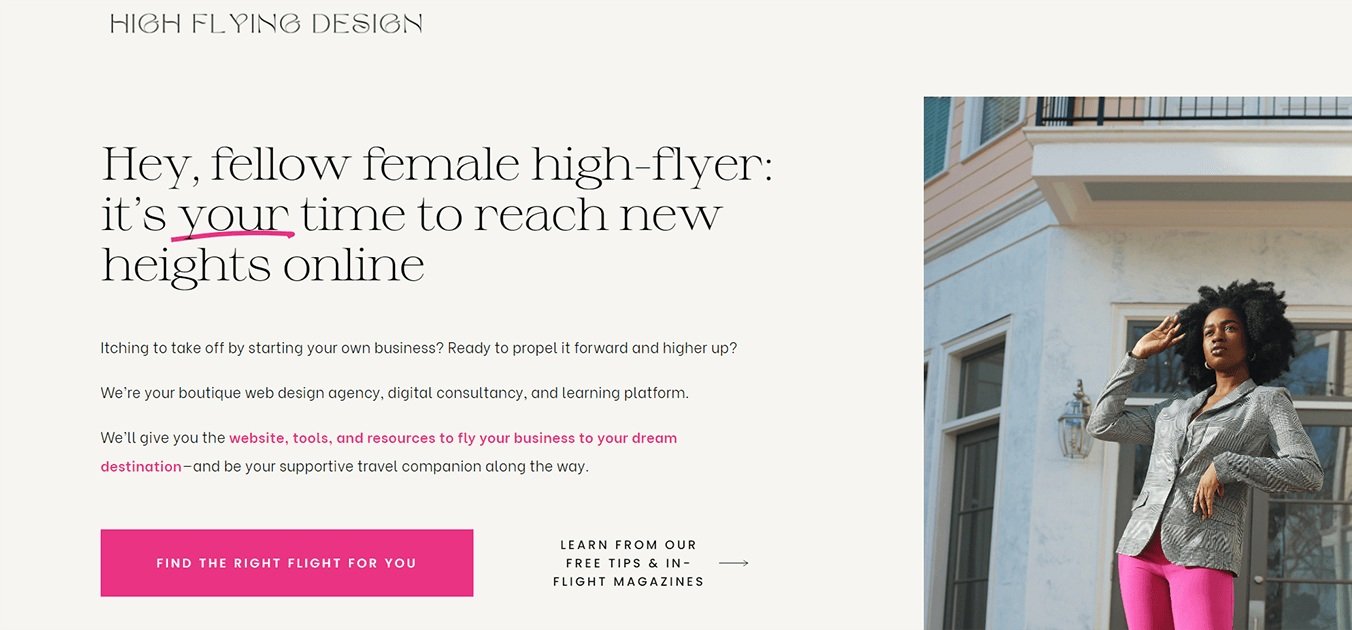
Key elements:
what type of business this is (“boutique web design agency, digital consultancy, and learning platform”)
who for (“female high-flyers”—like them)
how it benefits them (“take off by starting your own business”, “propel it forward and higher up” and, overall,“fly their business to their dream destination”) and what they can expect, specifically (“website, tools, and resources”)
what they should do next (“find the right flight for you” or, if they’re not ready to invest, subscribe to their newsletter to “learn from our free tips & in-flight magazines”)
And another snippet:
See? Written with an actual strategy, focused on their audience, and crystal clear.
How I can help you 1:1 and write website copy for your business
I hope my guide on how to write your website copy was useful!
But yeah, I can’t deny that it’s A LOT of work.

So, if you’d rather leave it to a professional instead of wasting weeks on trial and error, check out the 🧲Magnetic Message & Web Copy Makeover✨
With my brand messaging and website copywriting offer, you’ll get:

🧲A clear and fine-tuned brand message positioning you as THE go-to solution in your dream client’s eyes
🧲A strategic brand story woven around your target audience and following a proven framework
🧲Powerful website copy that cuts through the noise, connects, and converts… even when you’re sleeping or enjoying some well-deserved time off
🧲All the right SEO keywords to help your audience find you organically on Google when they’re looking for your type of business
🧲Bespoke brand messaging & storytelling guide so that you can always keep them consistent and amplify them through your content
Ready to go from “just another option in your niche” to “THE go-to solution for your ideal clients” in 3 weeks and start relying on website copy that actually sells for you 24/7?
More #crafty blog posts on this topic:
How to Use the 5 Pillars of Magnetic Marketing to Attract Clients
Spending too much time reaching out to people? Mainly attracting the wrong-fit prospects? Let's fix it by implementing the 🧲5 Pillars of Magnetic Marketing🧲

What if, instead of struggling to get leads and wow them with what you do, you could attract them organically? And by the time they get in touch with you, they’re already sold?
That’s the power of magnetic marketing—and specifically, my 5 pillars.
I’ll show you exactly what you need to focus on to implement them in your business.
Bu let’s start with a quick definition to make sure we’re on the same page.
What is magnetic marketing?

Magnetic marketing is a promotional strategy that focuses on attracting your dream audience organically—getting them to come to you rather than the other way around.
A few clarifications:
I didn’t “invent” magnetic marketing. As a concept, it’s been part of this industry for decades. In fact, Dan Kennedy branded it all the way back in 1993
Magnetic marketing doesn’t have to replace cold outreach or other outbound strategies (like paid ads). You can implement it alongside them, especially if they work well for you and your budget. Personally, though? I prefer inbound marketing
Why 5 pillars? You’ll find all kinds of tactics and combinations out there. But based on my experience and the results I’ve achieved for my clients, these 5 pillars are what bring the best results—when used together
And if you’re wondering, “WHAT results can I expect from magnetic marketing?”, picture this:

As you’re sipping your favourite morning brew, you turn on your laptop and find warm leads waiting for you in your inbox
You’re finding it easier to sell your services because your dream clients understand exactly how working with you will benefit them
You can confidently explain why they should choose you over your competitors
You’re finally showing up on Google and attracting your audience organically
You no longer have all your marketing eggs in the unreliable social media basket
From your newsletter to your social media posts, you’re writing content more easily because you’re clear on your brand message and story
You’ve gone from "just another option" to "THE go-to solution in your dream clients’ eyes"
This is what happens when you integrate my 5 Pillars of Magnetic Marketing in your business! Let’s look at them individually.
Giada Nizzoli’s 🧲5 Pillars of Magnetic Marketing🧲
(That’s me, by the way!)
Here are the core tactics and elements to focus on to start attracting your dream clients.
1. A fine-tuned brand message

You must always be able to summarise exactly what you do, who for, and how this benefits them (example of a brand message that I fine-tuned for a fabulous client of mine: “We’re a boutique web design agency, digital consultancy, and learning platform helping female high-flyers reach new heights online”)
Make your brand messaging clear and specific: don’t fall for vague and fancy-sounding buzzwords that don’t actually mean much (e.g. say “premium Canva templates for your social media” if that’s what you sell. NOT “social media solutions”)
Keep your core message consistent across all your marketing materials. Otherwise, if you keep changing your focus and wording, it’ll be harder for your dream audience to remember what your business is about
2. A strategic brand story

Storytelling in marketing leads to a 30% increase in conversions!
But no I’m not talking about your entire backstory. Weave your brand story around your audience by positioning them as the hero. You? You’re the helpful guide—the Fairy Godmother to their Cinderella, in other words
Empathise with your audience’s pain point, show them why you're the best person to solve it, and make them feel the difference they'll experience once they invest in you
3. Website copy that cuts through the noise, connects, and converts

Your website copy shouldn’t describe your business: it should actively SELL for you 24/7!
So, it must include all the right conversion copy elements to take your audience from prospects to paying clients
Use it to spin your brand story and keep your message consistent: connect with your audience based on their current pain points, position yourself as the best possible solution for them, paint a picture of their happy ending, and give them a strong call to action
4. SEO

The majority of your audience don’t know about you, but they are out there looking for a solution to their problem
If you haven’t optimised your website copy for the right keywords, your dream clients will find your competitors instead
For example, my clients don’t usually find me because they googled ‘Crafty Copy’ or ‘Giada Nizzoli’. They were looking for keywords like ‘copywriter for female entrepreneurs’ or ‘website copywriting services’. So, you should incorporate the most relevant keywords for your business into your website copy
Disclaimer: nobody can guarantee a 1st page ranking!
But SEO-friendly website copy does give you the best chances of showing up in front of your target audience—and why exactly would you want to leave them to your competitors?
And blogging on your website regularly? It gives you an SEO boost and helps you attract the 95% of your audience who’re not ready to buy (yet).
5. Content that amplifies your brand message and story

Your conversion-focused website copy will do the heavy-lifting when it comes to people who were actively looking for your types of services—or who’re ready to buy, by now. But as teased before, 95% of your audience are NOT there yet! That’s where your magnetic marketing content comes into play
Depending on your strategy, this can be the blog on your website, the social media platforms where your audience is lurking, your newsletter, and so on
Overall, your content should help you attract your target audience, retain them (when they’re not ready to buy), and then move them down the sales funnel (until they are)
So, you must always write it with a strategy. Instead of creating content that only gets you likes and comment from your industry peers, refer to your brand message and story to craft magnetic marketing content that speaks to your actual dream audience
Keep in mind that some of these strategies (like SEO and content marketing) are about the long-tem game.
The sooner you put these foundations in place, though, the sooner you’ll see the first results.
And some other pillars (like a fine-tuned brand message)? You’ll feel the difference straightaway. How cool is that?!
Shall I put the 5 Pillars of Magnetic Marketing in place for your business?

Have you not been attracting many of your dream clients organically, so far? Do you encounter a lot of resistance when it comes to pricing, perhaps because the prospects you attract don’t actually see the value of what you do?
Then it’s beyond time to put the 🧲5 Pillars of Magnetic Marketing🧲 in place—and stop relying on the pillars of sand that are vague messaging, weak copy, and content churned out without a strategy.
After all, I’m sure you’re already incredible at what you do. Let me repackage it in a way that makes your dream clients go, “where do I sign up?!”
More #crafty blog posts on this topic:
7 Reasons Why You’re Not Getting Clients (& How to Fix Them)
And relax: it's unlikely to be because of your actual skills! So, here's exactly what to do about the most common reasons why you're not getting clients.

As a service provider, you’re INCREDIBLE at what you do. So, why are you not getting clients as smoothly as you’d like? Or better: why are you attracting wrong-fit and low-vibe clients, rather than enough of the high-level ones you love working with?
Here’s the truth bomb:
at this stage, it doesn’t matter how good you are at what you do. If you can’t attract your target audience and convert them from prospects to clients, they’ll NEVER find out.
That’s where your problem is likely to be!
So, we’re going to look at 7 common reasons why you’re not getting clients and, most importantly, what you can do to fix them.
But let’s double-check something real quick.
Disclaimer: you first need to have the right foundations in place!

In some cases, there might be deeper and bigger reasons why you’re not getting clients, and they require your attention before you fix any of the ones we’ll look into in the core of the article:
You don’t know who your dream audience is. If you’re tempted to answer “but my services are for everyone”, then hear me out: when you try and please everyone, you please no one. So, take some time to look into this properly. Conduct some research, narrow down your audience, and understand exactly who you’re selling to
You haven’t got the right offer for your audience. Your services should solve your dream client’s pain point, offer a desirable transformation, and be priced accordingly. If your offer is something they can easily live without or it’s just too expensive for their budget (or even suspiciously cheap)… then that’s probably why you’re not getting clients. So, run a competitor analysis to see what’s already working out there, get some honest feedback from your target audience, and consider redesigning your services accordingly
Not sure if you’re targeting the right audience and with the right services? Easy:
Do you know of any competitors who’ve got similar services for your audience—and who’re doing well?
Have you sold your services before?
Did you receive positive feedback?
Do you get clients from referrals, occasionally?
If you’ve just answered “yes” to those, then… congrats: there’s nothing wrong with your actual audience focus and services (pheeew) and the rest of this blog post is indeed right for your current situation.
7 main reasons why you’re not getting clients for your service-based business—and what to do about it
And I’m confident it’s at least one of the following because that’s what most of my clients used to struggle with.
Full disclosure? I had the same problems in the past!
So, trust me: I know how frustrating it feels. Luckily for you, I now know how to solve them, too.
If you’d rather do all this with the right support and guidance, you might be a good fit to become The Intentional Authority. During my 12-week 1:1 programme, you’ll implement more efficient, structured, high-impact marketing to gain back hours and headspace every week while attracting more of the high-ticket, perfect-fit clients who energise you. Check if it’s for you
1. You’re not clear on your brand messaging
Your brand messaging is the way you write and talk about your business, the core topics you focus on, and how you convey your value proposition to your specific audience.
In other words, it’s what allows you to set yourself apart from your competitors and grab your dream client’s attention—and retain it.
Your brand messaging should also be consistent everywhere, from your website copy to your social media posts and… all your marketing materials
For example, does your website say “I’m a graphic designer on a mission” but your social media bios are “I offer graphic design services for solopreneurs” and your LinkedIn headline says “I’ve completed +100 graphic design projects and social media templates for my clients”?
Then your audience won’t be able to understand what your brand is actually about.
And if they can’t understand it, they won’t remember it.
And if they don’t remember it, they won’t automatically think of you when they’re finally ready to invest in a solution to their problem.
How to fix this reason why you’re not getting clients:
You can start by brainstorming exactly:
What you do/what type of business you are
Who for
How this benefits them/why they should care
and then keep this focus and precise wording consistent across all your marketing materials.
2. You’re not welcoming your dream audience into your brand story
Storytelling in marketing can get you a 30% increase in conversions. Only when done right, though!
Is your brand story all about yourself and how passionate you are about your business?
Do you post content that focuses on you and whatever you’re “excited to announce” and “delighted to share”?
Then that’s likely to be one of the main reasons why you’re not getting clients.
I’ll tell you a secret: people are selfish. We all are. And that includes your target audience. So, if you keep talking about yourself and your business, they won’t care.
But you know what they LOVE hearing and reading about?
Themselves (told ya they’re selfish).
So, adjust your brand story accordingly.
How to fix this reason why you’re not getting clients:
Place your dream client at the core of your brand story, connect with their pain point, position yourself as the best person to solve it, and make them feel this transformation.
Your website copy can tell the entire story, and your content can amplify it.
So, make sure most of it is about your dream clients. Less “I/we”, more “you.”
3. Your website copy isn’t optimised for conversions

One of the most common reasons why service providers don’t get clients? Because their website copy doesn’t actually sell their services. It just describes their business.
“We offer x, y, and z.”
“We’d love to hear from you.”
“We are passionate about working with…”
Does this sound familiar? In most cases, it’s because you wrote your own copy or outsourced it to the cheapest copywriter you could find.
And hey, it’s ok: we’ve all gotta start somewhere! However…
Your website copy should actively be generating high-quality leads for you. If it hasn’t been doing that, then it sounds like it’s time to upgrade it.
For example, amongst the various conversion elements it must include, there’s tackling your dream client’s objections. Maybe they’re considering investing in your services but are thinking “or I could just do it myself.” If your website copy doesn’t address this objection, those prospects will leave without getting in touch—and try and do it themselves.
How to fix this reason why you’re not getting clients:
Invest in conversion-focused website copy that’s written with an actual strategy and that actively sells for you (24/7, no breaks or holidays allowed).
4. You’re not relying on SEO

Most of your dream clients don’t know about your business or name, but they are out there looking for a solution to their problems and googling your type of services.
If you don’t show up on Google at all, that’s probably why you’re not getting many clients: they’re finding your competitors instead!
How to fix this reason why you’re not getting clients:
When you invest in new website copy, make sure it’s optimised for search engines as well as for conversions. This will give you the best chances of attracting your dream audience organically on Google
Blog on your business website. Your core website pages will help you attract prospects who’re looking to invest in your types of services, but 95% of your audience are not ready to buy yet! That’s a pretty big chunk you’re forgetting about. So, write educational and relevant content for those who’re still trying to understand their current problem, what’s causing it, how it can be solved, and so on. That way, when they’re ready to invest in a solution for it, you’ll be the first name that comes to mind. Plus, blogging regularly will give a powerful SEO boost to your entire website. So, you’ll help your core website copy reach more of your audience, too
5. You haven’t been consistent with your marketing…

Do you only think about your marketing when you’re not getting clients? Do you go on a marketing spree and then disappear like that guy who ghosted me and still has my tupperware?
Then that’s what’s been working against you.
Social media marketing, newsletters, blogging… they’re all about the long-term game. So, you must stay consistent even when you’re so busy that you wouldn’t be able to take on any more clients (it’s OK to turn down work, and you can always put those people on a waiting list).
Otherwise, if you only send out newsletters or post on LinkedIn when you’re going through a dry spell, it’s too late—and your lead pipeline will keep on drying up.
How to fix this reason why you’re not getting clients:
Figure out how you can be consistent with your marketing while still putting out excellent content. Basically, be realistic!
I’m not telling you to show up on all your platforms every single day if that would cause you to have a breakdown.
But, for example, you could aim to post on your social media three times a week, email your list once a week (or even every fortnight), engage with your audience by replying to comments every day, and post one blog post a month.
Either way: consistency and quality > quantity and sporadic marketing sprees.
6. … or you’ve been putting out content without the right strategy

There’s a reason why, in the previous point, I said “excellent content” and not just “any type of content.”
Consistency is key, of course, but… churning out content just for the sake of marketing yourself regularly? That won’t get you more clients either.
For example, I noticed that some people complained about not getting any results from LinkedIn even though they were posting every day. And guess what?
They were copywriters sharing copywriting tips for other copywriters (hint hint: fellow copywriters aren’t planning on hiring them! Most of us write our own copy).
Or graphic designers talking to other graphic designers in their posts… even though they offer services for business owners who know nothing about graphic design.
And if you’ve realised you’ve been doing the same, don’t be harsh on yourself: it’s a common pitfall. Luckily, you can choose to climb out of it right now.
How to fix this reason why you’re not getting clients:
Always write your marketing content with your specific dream audience in mind.
What are they struggling with right now? How would they feel if their problems were solved? What’s stopping them from investing in your services right now? What’s a valuable tip or piece of advice you can share with them?
So, refer to your brand messaging and story, and make sure your content is strategic and right for your audience.
7. You’re not actually asking for a sale
This might sound like a silly question, but let’s get real: have you been selling your services? As in, are you actively promoting them?
Because so many service providers who complain they’re not getting clients aren’t actually asking for that sale. But if you don’t ask, you don’t get!
And if you’ve been made to feel that selling is sleazy, let me reframe this for you:
if you have a service that can solve your dream client’s problem and make a positive difference in their lives, why on earth would you NOT want them to find out about it? Why would you NOT want them to invest in you and make this powerful transformation happen?
How to fix this reason why you’re not getting clients:
Aim for an 80:20 ratio of educational/informational (80%) and promotional content (20%).
Make sure you include a powerful and clear call to action, too: if someone reads your promotional social media post or newsletter and wants to take action, they need to know exactly how to get started right freakin’ now.
If you’d rather do all this with the right support and guidance, you might be a good fit to become The Intentional Authority. During my 12-week 1:1 programme, you’ll implement more efficient, structured, high-impact marketing to gain back hours and headspace every week while attracting more of the high-ticket, perfect-fit clients who energise you. Check if it’s for you
How I can help you get more clients for your service-based business

I hope my guide was useful. Let’s face it, though: it’s hard to implement everything yourself and, most importantly, stick to it.
So, if you’ve been running a profitable business for years but, to get clients, you’re still relying on unpredictable word of mouth, a lot more effort than you’d like, and endless calls and back-and-forths with “I’ll think about it” prospects… you don’t have to waste even more time trying to figure it all out on your own or throwing spaghetti at the wall.
You can get complete clarity, a strategy, and a system to consistently market your services as the ONLY logical choice, attracting more perfect-fit, ready-to-start clients who want to work with you—and finally feeling and being seen as the authority you already are
More #crafty blog posts on this topic:
What’s Brand Messaging? (You Need It BEFORE Copywriting)
Investing in copywriting without first having clear & strategic brand messaging? It’d be like laying bricks without any foundations. Here’s why.

Forgot about brand messaging? Then your audience will forget about you.
Or better: your business won’t pop into their minds when they’re finally ready to invest in the type of services or products you sell.
Shall we bypass this not-so-delightful scenario?
Find out why you desperately need to work on your brand messaging (and yes, that’s before you write or invest in new copy).
Understanding brand messaging

Let’s start with a simple definition.
What is brand messaging?
Brand messaging is the way you talk and write about your business, what you focus on the most, and how you convey your specific value proposition to your target audience in a way that resonates with THEM.
It’s how you communicate your mission, brand story, and personality across all of your marketing channels.
And, of course, in order to communicate them effectively… you first need to be crystal clear on what they actually are for your business!
Brand messaging examples
Brand messaging isn’t really something you can “see”. It’s more about how you make your audience feel about your business and what you help them focus on (and remember).
Still, I’m gonna share a couple of snippets to give you a flavour of just how big a difference this can make.
The following brand messaging examples are from the websites of two coaches for female entrepreneurs:

MG Coach uses a straight-to-the-point, matter-of-fact tone that inspires confidence. Even though her services help her clients improve their overall life too, her focus is clearly on business. More specifically, on getting results “faster, better, easier.”
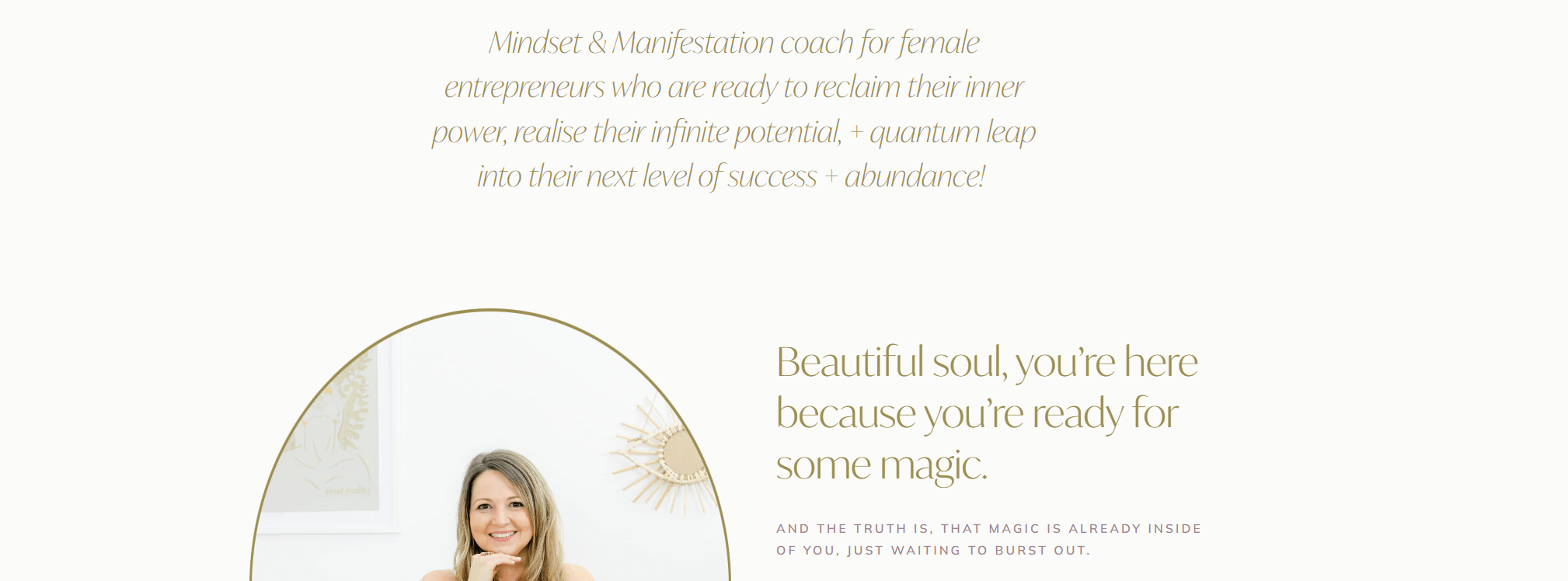
Becky Stanton has an uplifting tone, which makes her clients feel empowered and sense an instant connection with her (e.g. “and the truth is, that magic is already inside of you.”). Her focus is on helping them create an abundant life overall.
See? They’re both coaches and both working with female entrepreneurs, but their brand messaging paints a completely different picture right from the start.
When you master this, you’ll start attracting and connecting with your dream clients—and repelling the wrong prospects, which is just as important.
And what is a brand messaging framework?
A brand messaging framework is a document that clarifies elements like your value proposition, core focus, and tone of voice. It also includes guidelines on how to keep your communication consistent when talking about your business.
That way, it doesn’t matter if it’s just you, if you have a team, or if you’re planning on outsourcing some aspects of your business: a brand messaging framework will ensure that its focus stays consistent no matter who’s writing about it, when, and on what channel.
Why you need brand messaging—before hiring a copywriter
And for full transparency: this comes from someone who used to be known for her standalone copywriting services. One of the main reasons why I pivoted and swapped them for a brand messaging & website copy offer?
Because I told you: you really do need to fine-tune your brand messaging before hiring a copywriter.
And I had to learn that the hard way.
I’ll tell you why through some examples, but let’s first focus on those core reasons.
1. Without clear brand messaging, you’re “just another option in your niche”

… and you’d be leaving a ton of money on the table.
Because if you:
❌ can’t communicate what sets you apart from your competitors
❌ aren’t clear on WHAT to focus on when marketing your business and HOW to say it
❌ can’t articulate the value of your services or products in a way that resonates with your audience
… why should your dream prospects choose you instead of your competitors?
Brand messaging, on the other hand, allows you to fine-tune your value proposition and communication so they connect with your specific audience.
That way, choosing you becomes a no-brainer.
2. If you’re not clear on it, you can’t expect your copywriter to convey your brand message through your copy

Newsflash: copywriters can’t read minds (yet).
That’s why, before starting a project, they’ll get you to fill in a brief. If you’ve never thought about your brand messaging, though, you won’t be able to do that. Or you’d end up giving extremely vague answers… which would then lead to extremely vague copy.
For example, before becoming a brand messaging consultant as well as a copywriter, I worked with clients who’d answer like “oh, we REALLY care.” The question? “What sets you apart from your competitors.” You can see why that wouldn’t be enough, now, can’t you?
Or a fellow copywriter told me that a client expected her to nail their personality even though all they had told her about it was “We’re like an oat milk latte.”
Instead, when you’re clear on your brand message, a copywriter will be able to clarify and amplify those core concepts through your copy, crafting words that actually SELL.
3. You’d end up confusing your audience whenever you write or talk about your business

When I used to offer standalone website copywriting services, my clients would obviously receive strategic words that positioned them as THE go-to solution for their target audience.
But then I realised there was a big problem:
sure, the website copy itself kept working in the background for them… but when my old clients wrote about their business on social media, their blog, and other channels?
Most of them would end up muddling that core message.
They’d start focusing on different things altogether or go from “Here’s what we can do for you” to “We are so passionate about this and that and blah blah boring”.
And that’s something I see online ALL. THE. TIME.
❌ The website copy tells one story (e.g. “I’m a graphic designer on a mission”)
❌ Their Instagram bio offers a different business summary (e.g. “I offer graphic design services for solopreneurs”)
❌ So does their LinkedIn headline (“I’ve completed +100 graphic design projects and social media templates for my clients”)
❌ So do their social media posts (“I’m here to make your brand more colourful.”)
❌ And so on
That’s why I eventually introduced a brand messaging guide as part of my signature offer: to make it a breeze for my clients to tell a consistent story and stay true to their brand messaging whenever and wherever they talk or write about their business.
Because here’s the truth: if your focus keeps changing, you can’t expect your audience to think of you when they’re finally ready to invest!
The right brand messaging helps your dream audience understand and remember exactly what you do and how it’ll benefit them.
So, make sure you are clear on that first and can always keep it consistent.
Nail your brand messaging with the help of an expert
By now, I’m sure you understand the importance of a clear brand messaging framework, but… I get it: it’s not easy to define it when you’re so close to your business.
After all, what you’re personally excited about (“I’m so passionate about my work”) is unlikely to be what your audience needs to hear.
Well, that’s one of the reasons why I niched down as a brand messaging strategist as well as a copywriter: to unlock and fine-tune my clients’ core message and brand story.

Perfect for fellow women service providers in particular, the 🧲Magnetic Message & Web Copy Makeover✨ will give you:
Brand messaging to position you as THE go-to solution for your ideal clients
Entirely done-for-you website copy that actually sells for you, even when you’re sleeping
Bespoke guide to amplify your messaging through your marketing (so that you always know WHAT to focus on and HOW to articulate the value of your services)
Ready to attract more clients who already want to work with YOU (and you only)?
More #crafty blog posts on this topic:
How You Can Use Storytelling in Marketing to Connect & SELL
Storytelling in marketing is proven to make you more memorable AND increase conversions. But no: it’s not about your story (sorry). Here’s what to do.
Sure, stories entertain, but did you know they could sell, too?
Yes. Using storytelling in marketing can really help you stand out from a crowd of ‘buy-this-now’ competitors.
It can make your audience think, “hey, she really gets me!” and “this brand can definitely help me.”
But here’s the problem: in most cases, you’ve either ignored storytelling altogether or… you’ve been spinning the wrong story.
Here’s why (and how to fix it so that you can actually start using storytelling as a marketing strategy).
Storytelling in marketing 1-0-OnceUponATime
Excuse the cheeky pun.
What does storytelling mean in marketing?
In marketing, storytelling means using a narrative (literally “telling a story”) to communicate a message to your audience.

This can take all kinds of different forms.
For example, storytelling as a marketing tool could involve long-form copy on a sales page, something that paints a picture of how your life feels right now and shows you the transformation you’ll experience after investing in that offer.
It could be a snappier social media post talking about how you took someone from A to B.
And… anything in between.
Now, don’t worry: it’s not about creating all sorts of characters and plots! You’re not writing a novel, after all.
Storytelling in marketing is simply about showing some kind of progression or transformation through your copy and content.
I’ll give you a proper storytelling marketing example later down the article, but first…
Why is storytelling important in marketing?
Storytelling is important in marketing because it helps you grab the attention of your specific target audience and make them want to invest in you. It also makes it easier for them to remember you.
And this isn’t my opinion: it’s a #fact. There’s an actual science and psychology behind marketing through storytelling!
Some quick stats to put marketing storytelling in context
Some specific chemicals are released in our brain when we’re told a story. Cortisol helps us formulate memories, dopamine regulates our emotional response, and oxytocin creates or maintains a connection because it’s associated with empathy
No wonder facts are 22 times more likely to be remembered when they’re part of a story! And being noticed and remembered can make all the difference for your business, especially since your audience is exposed to 6,000-10,000 marketing messages EVERY. SINGLE. DAY (yes, really)
Storytelling in marketing leads to a 30% increase in conversions. So, you’re A LOT more likely to turn those prospects into paying clients!
Why you might have been telling the wrong story

Using storytelling in marketing isn’t enough to succeed. You also need to tell the right story.
And here’s the mistake I encounter the most whenever I review existing marketing copy and content:
most business owners make this story about themselves.
Is that the case for you?
It might be if any of these sentences sound familiar:
“I couldn’t be more excited to announce that…”
“I started this business ten years ago, and it taught me that…”
“I’m passionate about what I do. That’s why I decided to turn it into my business.”
Those are some bad (but extremely common) marketing storytelling examples.
Now, don’t get me wrong: I’m NOT saying your story hasn’t got a place in your marketing. Not at all!
For example:
Can your own story inspire your ideal client to take action?
Is there a particular anecdote that can resonate with them based on their current situation?
Can your background show them why they should choose you instead of your competitors?
Does your story feed into a bigger mission that your audience is also on board with?
Then, go on, and share those stories!
And let’s not forget that personal stories can help you grow your own personal brand (well, it’s in the name).
Just… don’t plan your entire website copy and storytelling content around them.
“Then, what type of storytelling in marketing SHOULD I use, Giada?”
Why, I’m so glad you asked!
How you can start attracting (and converting) your audience by using copywriting and content marketing storytelling ✏️
There is ONE story you should tell ALL. THE. TIME.
The core of your content and communication should be based around it, too.
And when you get this brand story right? That’s when your storytelling in marketing becomes a lead-generating machine.
1. Understand and accept that your audience is the hero of your brand story
Sorry, I don’t mean to rain on your parade, but:
“The customer is the hero of our brand’s story, not us.”
(PS: I highly recommend his book, Building A Storybrand)
So, whenever you’re using storytelling in marketing, remember that the trick is to make them the protagonist of your overall brand story.
“But Giada, where does that leave ME?!”
2. Position yourself/your brand as the guide

Even though you’re not the hero, you still have a pretty cool part:
you’re the wise, trusted, and helpful guide.
You’re the Fairy Godmother to their Cinderella. The Obi Wan to their Luke Skywalker.
In other words, you are the one who can help the hero get to their happy ending (if they invest in your brand).
3. Tell their story

Now, I’m not gonna lie: I have a bespoke, proven framework for my web copy creation and storytelling content strategy.
So, I can’t reveal every single ingredient inside my secret sauce (it wouldn’t be fair on the badass clients who pay for it, would it?)
But, to give you a general idea, here are the core parts of that story:
INITIAL SITUATION: the hero (= your dream client) has some kind of pain point that’s making their life or business more complicated, stressful, overwhelming, etc.
INCITING INCIDENT: the hero meets a guide who offers them the tools to solve it. In fact, this guide has already helped other heroes overcome that initial struggle!
HAPPY ENDING: if the hero decides to invest in that guide, they will replace their current pain point with a positive outcome. They’ll go through a transformation and feel confident, empowered, relaxed, etc.
That’s what you should base your brand story on.
Not how passionate you are about collaborating with your clients. Not how excited you are to send them your products.
Successful storytelling in marketing is about how your brand can solve your hero’s problem and offer them a happy ending.
4. Amplify your content marketing storytelling by sticking to the same story

That brand story should be extremely clear on your website in particular.
Sadly, here’s another common problem when it comes to brand messaging and copy: each channel seems to tell a different story or focus on a separate aspect of it.
If you want your audience to understand and remember your story, you need to tell a consistent one. Brand story marketing won’t work if that narrative is unclear on all over the place.
Sure, some elements will change slightly depending on the format and campaign.
For example, if your client is experiencing three core pain points, you can tackle each of them individually in a different social media post.
But every piece of your content marketing storytelling strategy should still refer to that overall narrative.
Basically, you want your audience to know that, if they want to solve their current problem and achieve their happy ending, YOU are the best possible brand for it.
You can’t do that effectively if your message and story get muddled whenever you write or speak about them.
Use strategic messaging and storytelling in your marketing to attract your ideal clients
Storytelling will make a huge difference for your service-based business, but it’s just one piece of your marketing puzzle (which doesn’t actually have to keep feeling like a messy puzzle).
As a marketing message mentor, I give women complete clarity, a strategy, and a system to consistently market their services as the ONLY logical choice, attracting more perfect-fit, ready-to-start clients who want to work with THEM.
If that sounds like your kind of happy ending, let’s start writing the first chapter together.
More #crafty blog posts on this topic:


