Why Is My Website NOT Showing on Google (& How to Fix It)
Wrong keywords? No sitemap? There are many reasons why your website isn’t showing on Google, but… the good news? They’re all fixable! Here’s how.
“Ugh, WHY is my website not showing on Google?!”
Lots of business owners end up asking themselves this question at some point (so, if it makes you feel a teensy bit better, you’re not alone).
But I get your disappointment.
Maybe you thought all you needed was to create a quick website, churn out a few words per page, and people would have magically started finding it?
Well, the last part can still be true in a few months, but if your website isn’t showing up on Google just yet, you first need to fix some common problems.
So, to help you understand why some websites show up on Google and others don’t, let’s start with a simple, jargon-free overview.
Conditions needed for websites to show up on Google (psst: this is what you must aim for)

Websites that rank on Google and other search engines meet all 3 of these conditions:
Google knows that this website exists in the first place (no, it’s not a given!) and can easily find and access all its pages
This website contains a page that is a relevant match for a specific keyword (as in, a string of words, like “website copywriter for hire”)
It has proved to Google that that specific page DESERVES to rank for that keyword because it’s one of the very best and most valuable on that subject
How do I get my website to show up on Google, in a nutshell?
Basically, to get your website to show up on Google, you must:
Make it easy for search engines to find and understand your pages
Optimise most of them for on-page SEO, and your entire website for off-page SEO (don’t panic: I’ll show you how soon!)
Include relevant, high-quality content that stands out against your competitors
In other words, you have to meet the 3 conditions we just covered.
I’ll explain to you how as soon as we start looking at the reasons why your website isn’t showing on Google in the first place, but first, let’s be realistic.
How long does it take for a website to show up on Google?
This search engine’s algorithm is constantly changing and takes several factors into consideration. So, it could take as little as 4 days for your website to show up on Google or as long as 6 months.
However, this simply means that Google has started crawling it and attributing authority to your domain (which are fancy words for “acknowledging its existance and starting to understand its value”), NOT that you will already show up on the 1st page for your target keywords.
As I always say, be realistic: SEO takes time!
For a website page to reach the top results, we’re talking about 6-12 months or longer. In fact, only 5.7% of the pages ranking in the top-ten results of Google’s 1st page were published within the year.
Once again, this won’t happen automatically: your page needs to meet the 3 conditions we looked at.
Now, truth bomb: if you’ve been asking yourself ‘why is my website not showing on Google’, the chances are… your situation will be the exact same in 6 months IF you don’t do anything about it.
Buuuuuuut you’re here! So, that tells me you’re actually going to put my tips into practice and fix it, right?
Why is my website not showing on google? Top 14 reasons & solutions
My advice? Bookmark this blog post right now so that you can go through EVERY. SINGLE. ONE. without forgetting about it or getting overwhelmed.
1. You have only just launched your website

Ok, slow down then, my friend! If you’ve literally only just created your business website, it’s TOTALLY normal that it isn’t ranking.
As we’ve seen earlier, it can take up to 6 months for Google to notice it.

However, there are a few things you can do to speed up this process. High five!
How to fix this reason why your website isn’t showing on Google
Create a Google Search Console account and link it to your website
Then, create a sitemap and submit it through Google Search Console: Sitemaps -> Enter sitemap URL -> Submit
A sitemap is simply there to help search engines understand the hierarchy of your website pages and show them how to crawl them correctly (as in, how to go through them and make sense of them).
How you create a sitemap depends on what platform you’ve used to build your website, but most of them let you do it automatically (how cool is that?!)
2. Your business doesn’t exist aaaaaaaaanywhere else
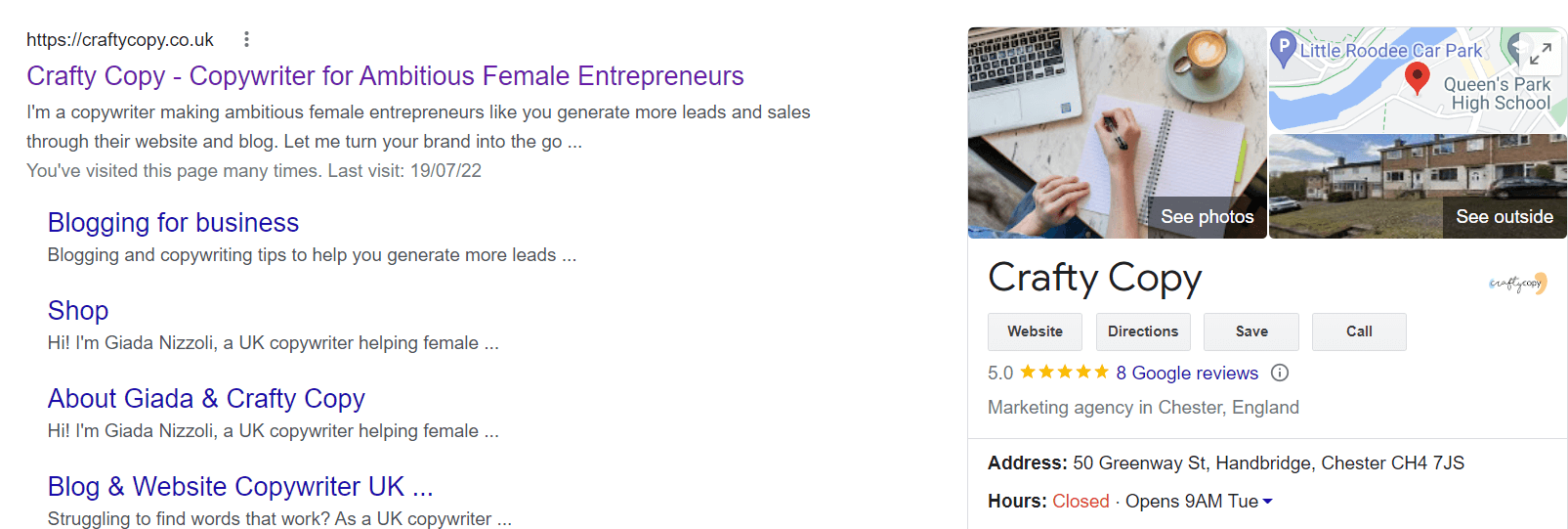
Example of how my website shows up on Google thanks to my Google My Business page
If you’re wondering ‘why is my website not showing on Google’ and you don’t even know what Google My Business is, well… this might be THE answer for you.
The thing is, you probably do know about it—and have seen it before—but aren’t familiar with the name.
How to fix this reason why your website isn’t showing on Google
You know when you google something and you’re presented with a separate section on the right (with pictures, a link to the company’s website, contact details, and an overview)?
That’s what your potential clients will also be able to see if you register on Google My Business! This means you’ll also show up on Google Maps, which is always handy (but even more so if you offer your services locally)
You should register your website on other relevant directories too, though. For example, if you have a restaurant, you’ll want to be on TripAdvisor. If you provide your services locally, check out Yelp, and so on
A trick? Just type your industry name and then ‘business directories’ on Google, and you’ll find all the relevant ones for you.
3. You’re stopping search engines from indexing or crawling your pages (so, they can’t find your website!)

Uuuuuuh, it’s getting technical. Sorry about that.
But the good news is… this is highly unlikely to be the reason why your website isn’t showing up on Google, especially if you haven’t touched any code or ticked any weird boxes.
If your neighbour’s brother’s cousin has built your website for free, though, you might want to check it—just to be on the safe side.
How to fix this reason why your website isn’t showing on Google
There’s something called noindex tag that basically tells Google you DON’T want it to look at specific pages. So, these ones will never show up as a search result, no matter you someone type. You can use tools like Ahrefs to check if there are any noindex tags on your website and remove them
Most websites have a robots.txt file that tells search engines what they should and shouldn’t crawl. If you added some pages to that file (maybe by mistake), that’s why your website isn’t showing on Google for them. So, go to your Search Console account, look for the Coverage report, and see if there’s any ‘submitted URL blocked by robots.txt’ error
4. Your website has been penalised by this search engine

Once again, this is extremely rare, but… better safe than sorry!
If you annoyed Google by spamming people or using dodgy practices that go against its terms of service (like buying backlinks), this touchy search engine miiiiiiiiight have done one of the following to your website:
Deindexed it – Your domain has been banned (aka removed)
Penalised it – Google knows your website exists, but it’s making it pretty much impossible for people to find it organically
Sandboxed it – Imagine Google putting your website to the side for a bit until it can fully figure out whether you’re legit or spam
How to fix this reason why your website isn’t showing on Google
Log into your Google Search Console account
If you find a notice that mentions one of those 3 terms, it will also tell you the reason behind it (hint hint: that’s what you must fix)
5. It’s too slow and takes aaaaaaaaaages to load

You know who HATES slow websites?
Google, which prefers websites that load in max 2 seconds
Your ideal clients. In fact, more than 1 in 2 will leave if your website takes longer than 3 seconds to load
So, if yours is too slow, that’s probably why your website isn’t showing on Google.
How to fix this reason why your website isn’t showing on Google
Work with a professional website developer, if you can
Run a Pingdom or Google speed test, and implement the tips you receive within their reports
6. It’s not optimised for phones

Around 1 in 2 website visitors comes from phones. Is your business website mobile friendly?
For example, if it involves static pages (that force mobile users to zoom in just to read the text) or large buttons that are tricky to click on with a thumb, it’s clearly not.
How to fix this reason why your website isn’t showing on Google
Run a mobile-friendly test
Fix the mistakes that flag up
7. It results in poor UX (user experience) overall

If Google realises your current website visitors aren’t having a good time, it isn’t going to show it to many more people. Sorry!
What do I mean by that?
Poor UX takes different forms, but, for example, it could involve difficult navigation (like, dozens and dozens of pages linked in the main menu), loud videos that start playing automatically, long dropdowns in forms, etc.
How to fix this reason why your website isn’t showing on Google
Consider getting some honest feedback from a few of your ideal clients, asking them to navigate your website on their own and finding out if there’s anything they struggle with
You can also test your UX with tools like Fivesecondtest, Optimizely, Crazy Egg, or UX Check
8. It lacks authority and backlinks

Here’s where things start to get trickier, but nothing that the right strategy (and patience) can’t fix.
Basically, when choosing which websites to prioritise, Google relies on something called PageRank. This algorithm looks at looooooooots of factors, but a big one involves links, both internal links (from one page of your website to another) and backlinks (when a different website links to a page on yours).
If you haven’t got many, that’s probably why your website isn’t appearing on Google.
How to fix this reason why your website isn’t showing on Google
Add internal links whenever possible and relevant. For example, when you mention your eco-friendly values on your homepage or in a blog post, link to your Sustainability page. This helps Google better understand your website!
As for backlinks, I’ll be honest: they won’t happen overnight. Even more honest? Nobody wants to link to your About or Service page. As well as guest posting (= writing articles for different websites that also let you link to your own), a good strategy to attract external backlinks is to blog on your business website, sharing insightful blog posts that bring value to your ideal clients and answer their questions
Spoiler alert: not having a blog is another HUGE reasons why your website isn’t showing on Google, but we’ll look into it properly before the end of this article.
9. It doesn’t look trustworthy to Google

Would you send your friend into a shop that looks pitch black, with employees staring at customers in an intimidating way? Probably not, and neither would Google.
If your business website doesn’t look trustworthy, it’s not going to rank very high.
How to fix this reason why your website isn’t showing on Google
Just like you’d get a dog to smell your hand first, some of the things you can do to get Google to trust you are:
Using an SSL certificate
Adding social proof like reviews from your happy clients
Being transparent with your policies and Ts&Cs (you should have a page for those)
Linking to your socials
Collecting positive reviews on Google and online, too
10. Your website pages are too short

If someone told you they wanted to learn more about planning a trip to Iceland, for example, would you give them a four-page flyer or a 100-page guide?
Likewise, Google raaaaaarely trusts a short web page to have enough value for its users.
How to fix this reason why your website isn’t showing on Google
Whenever possible, aim for at least 300 words on each page, which is considered the minimum for SEO
For the best results, invest in website copywriting services to receive fresh and strategic copy that hits the sweet spot: as long as it NEEDS to be (= to turn more visitors into paying clients) and as short as it CAN be (= no fluff and redundant sections) while still taking SEO best practices into account
11. You have duplicate content on your website

If, for whatever reason, you repeated a good chunk of text across different pages, it means you created duplicate content… and Google doesn’t like that.
Same if you copied long bodies of text that you’ve found on someone else’s website (naughty!).
You see, search engines want your pages to be UNIQUE! So, make sure that’s always the case.
How to fix this reason why your website isn’t showing on Google
Start posting original and unique content only
If you think you might already have some duplicate content, run a test to double-check and fix it
12. You haven’t taken on-page SEO into account...

Some of the techniques we covered—like attracting backlinks or improving your website’s speed—are called off-page SEO.
However, if your website isn’t showing on Google, you shouldn’t forget about on-page SEO either: optimising every page to help search engines understand it (without ruining the experience for your human visitors).
How to fix this reason why your website isn’t showing on Google
Use keyword research tools to find out WHAT your ideal clients are googling when looking for your type of business or services
Incorporate the most relevant keywords in all the right spots (whenever possible and natural): your page title, headings, a few times within the body of your copy, image alt text, and page URL in particular
Unless you only sell your services online, local SEO can be extremely helpful, too (for example, with location-based keywords like “best cafe in Chester”).
13. … or you targeted the wrong keywords

Perhaps you did think about on-page SEO, but you simply used the wrong keywords. What do I mean by ‘wrong’?
Usually, they’re either too broad and competitive (for example, unless you’re Coca Cola, you’re unlikely to rank for “best fizzy drink”) or they don’t match search intent, which means they don’t meet your ideal clients’ expectations (for example, you picked a keyword searched by people looking for informational content but, instead of a blog post, you used it on a sales page).
How to fix this reason why your website isn’t showing on Google
Be realistic: aim for more specific and niche keywords that are super relevant to your type of business and the services you offer. While they might be searched fewer times per month, they’ll bring you more of the right people
When you invest in my web copywriting services, I also conduct keyword research to give you the best chance of showing up on Google
14. You haven’t been blogging on your business website

If, after going through (or fixing) the previous points, you’re STILL wondering ‘why is my website not showing on Google’, then one of the most probable answers is simply that… you haven’t got a blog.
Or you do have one, but it’s all about your announcements, or you never update it. No, no, NO!
Every business website should have a blog full of valuable articles that entertain and educate its target audience.
While blogging comes with tons of benefits, lots of them involve search engine optimisation. So, how does blogging help with SEO (aka how does it help your website show on Google more often)?
Simple:
It provides fresh content, giving Google more opportunities to revisit and understand your website
It results in many more indexed pages (every blog post is also a new webpage!), and search engines looooove meaty websites
It allows you to target many more keywords, giving you plenty of chances to show up in front of your ideal clients
It offers all kinds of opportunities to add internal links
It attracts an average of 97% more backlinks
Blog posts are shareable, helping you reach more people via social media and amplifying their other SEO benefits indirectly
How to fix this reason why your website isn’t showing on Google
Too time-consuming? Haven’t got time to master this tactic, let alone create valuable content regularly? I can take care of your blog so that, other than sharing your perspective as a thought leader with me, you can just sit back and enjoy aaaaall those juicy results
So, ‘why is my website not showing on Google?’ As we’ve seen together, there are several reasons, but the best thing is... they’re all fixable (although you’ll still need to be patient to see the first results). Pheeeew!
How I can help your website show up on Google and sell your services more easily

I’m Giada, the marketing message mentor and strategist for women entrepreneurs. If you like my approach and you’d rather leave everything to a pro, the best option is the Magnetic Message & Web Copy Makeover: after clarifying your core message to turn you into THE go-to solution for your ideal clients, I’ll craft strategic and SEO-friendly website copy that actually sells for you
More #crafty blog posts on this topic:


What Is SEO Content Writing? Definition, Examples & Guide
SEO content writing is a game-changing marketing strategy to grow your badass female-founded business. Discover how it works & how you can create one, too!

Seriously, what is SEO content writing? Is it a complicated technique? A buzzword? A bird? A plane?
Actually, once you learn more about it, SEO content writing isn’t as hard as you might think, as a concept. In fact, it’s a marketing strategy that you can’t afford to miss out on as an ambitious entrepreneur.
The confusing bit is that you might have already heard about it but through other terms such as SEO blogging, content marketing, or blogging on your business website.
But, before answering your question ‘what is SEO content writing’, have you noticed how that term consists of two parts?
Let’s start by defining them separately to better understand the magic that happens when you put them together.
What is SEO?

SEO means search engine optimisation and consists of the practice of increasing both the quantity and quality of your organic website traffic through Google and other search engines.
This involves several factors. For example, whether your website is mobile-friendly, how fast it takes to load, if your contact details and information are consistent across the internet, etc.
However, the most famous and central one is keywords. Why?
Because that’s what your target audience types on Google, and that’s how they can (or can’t) find you.
For example, some of the keywords that are relevant to my business are ‘website copywriter’, ‘blog writer’, ‘freelance copywriter for hire’, and ‘copywriter UK’.
My main website pages are optimised for those!
What is content writing?

Content writing is an audience-oriented marketing strategy that has revolutionised the business world by replacing the old, corporate, blowing-your-own-trumpet mentality with a ‘let’s create valuable content for our dream customers’ approach.
Yes, it involves words, but content writing is slightly different from copywriting: while the aim of the latter is to generate sales, content writing is about attracting your target audience, retaining it, and building trust.
Sure, that will also lead to more sales eventually (duh!), but the writing itself isn’t usually built around the call-to-action to buy.
In fact, content writing mainly involves informational blog posts on relevant industry-related topics that your target audience cares about.
For example, if you sell a natural deodorant, the content writing strategy on your company blog could include articles on ‘the benefits of switching to a natural deodorant’, ‘all the harmful chemicals inside your store-bought deodorant,’ and ‘how to sweat less’.
Not company-focused articles on ‘our latest award’ and ‘what’s new at Natural Deodorant Ltd’.
Ok, then what is SEO content writing?
SEO content writing is a marketing strategy that uses keyword research to create insightful blog posts to attract and retain a company’s target audience.
Just like the definition of content writing, SEO content writing is about attracting your dream customers onto your website through these informational articles, turning them into a loyal audience, and, ultimately, generating more sales.
However, similarly to SEO copywriting, there’s a strong focus on keywords.
In fact, for your articles to be found by your audience, every single blog post must target a different long-tail keyword (consisting of three words or more).
Technically, ‘content writing’ and ‘SEO content writing’ should be synonyms: you can’t create a successful content marketing strategy without taking SEO and keywords into account.
Harnessing SEO content marketing on your female-founded biz website: 3 steps
So, what is SEO content writing in practice? It involves three main phases.

1. Creating an SEO content writing strategy for your target audience
As we’ve already established, a strong SEO content writing strategy involves a company blog on which you publish articles that your target audience will find interesting, useful, or entertaining (or all three at once).
It’s important to conduct some market and competitor research to find out what type of content they actually engage with.
While the blog posts will be related to your industry and products, it’s also helpful to brainstorm a few more specific areas and niches that you will cover.
For example, if you sell coffee, you could write brewing guides for different types of coffee makers, recipes for different coffee drinks, and educational articles (e.g. differences between roasts, why coffee is called joe, etc.).
2. Performing keyword research
When coming up with a new topic, you must also find the keyword that best describes it. Or, sometimes, you can even look for keywords first and use them to generate topic ideas!
There are two main reasons why keyword research is… key, when it comes to SEO content marketing:
In order to be found, every article must be optimised for a main one
You’ll find out what your target audience actually types, which might not be what you would
In fact, you might be used to referring to your second-hand garments as ‘retro clothing’.
However, that term gets searched 1K – 10K per month, whereas people are clearly more familiar with ‘vintage clothing’ since they search it ten times more often (10K – 100K).
3. Writing SEO-friendly content
Once you have a topic and a good keyword, SEO content writing is about writing the actual blog posts for your human readers and optimising them for search engines.
A good SEO-friendly blog post has a clear heading structure to facilitate readability, sticks to that specific topic rather than trying to squeeze a much broader subject into a single article, and… doesn’t actually feel like it involves SEO, when your target audience reads it.
How SEO content writing benefits your business

If you have a business website, you need an SEO content writing strategy!
(No blog page? Create it right now. You have one but it’s all about your company’s achievements? Turn it into an audience-oriented blog.)
The benefits of blogging for business with a strong SEO content writing strategy include:
More chances to rank with every new blog post (which is also an indexed page)
Higher SEO ranking for your overall website
Higher conversion rates
67% more leads than websites without a blog
Building trust
Positioning your company as an expert in your field
More content for your socials and newsletter
Cheaper than PPC and higher ROI
70% of consumers learn about a brand through its blog posts rather than paid ads
How I can help you with SEO content writing for your female-founded business 🙌

No time to write?
Not sure about how to optimise your blog posts to actually attract your dream customers from Google?
With my blog writing services, I can create a strong SEO content writing strategy and write the actual blog posts on a regular basis.
You just worry about enjoying the results.
More #crafty blog posts on this topic:
Benefits of a Website Copy Audit for YOU (A Game-Changer!)
Enough with counterproductive words! If you can’t afford full copywriting services just yet, unlock the benefits of a website copy audit ASAP.

So, you wrote your own website copy even though you’re not a copywriter (I get it: we’ve all got to start somewhere). You skim-read articles like ‘10 best website copy samples’ and spied on what your competitors are doing.
Is it working, though?
If you’re getting tumbleweed instead of new clients, you should definitely consider making the most of the benefits of a website copy audit.
After all, you’ve already invested in a website, and you pay for it on a monthly or yearly basis: isn’t it a waste of money if the words on it aren’t helping you attract more visitors and turning them into paying clients?!
Before diving into the benefits of a copy review, though, let’s look at exactly what it is.
What is a copy audit?

A copy audit or review is a popular service offered by professional copywriters (like yours truly): it involves reviewing your existing website copy objectively, giving you feedback and actionable suggestions on how you can improve it.
For example, some of the points I look at when conducting a website copy review are:
Is your core message simple and easy to understand, especially for someone who has NEVER heard about you and your business before?
Is the top section of your homepage (= everything we can see before scrolling down) clear and powerful enough to convey exactly what you do and how it benefits your target audience?
Have you used your SEO keywords correctly to maximise your chances of attracting your ideal clients through Google?
Is your tone of voice consistent?
Is your website copy easy to read, or does it compromise UX?
Are there clear and unmissable calls to action, or are your dream clients left wandering around without knowing what to do next?
Do I need a website copy review?
You need a website copy review if your website hasn’t been helping you attract visitors and turning them into paying clients for you—but you can’t afford full website copywriting services just yet.
Usually, this happens when you’ve written your own website copy, invested in it before getting clear on your USP and core message, or hired the cheapest copywriter you could find on Upwork.
Your current website copy might have been enough to get you started, but isn’t it time to take it to the next level so that it can start selling in the background for you?
A copy review will take your website from “just a monthly expense” to an active marketing tool with an outstanding ROI.
6 game-changing benefits of a website copy audit for your business
Here’s how it’ll benefit you in practice.
1. A website copy audit is an objective review

Here’s the thing: writing about your own business is… what’s the technical word? FREAKIN’ HARD.
I’m serious. You might think you’re the best person to do that since you know it like the back of your hand, but that’s exactly the problem!
You’re so close to your business that you’re bound to take too many things for granted when writing your website copy on your own – As I always say, “You can’t read the label from inside the jar, let alone write it.” Instead, you run the risk of confusing your visitors with industry jargon, overused buzzwords, or generic statements. At the same time, you could also fail to articulate the value of your services in a way that does them justice (and makes your ideal clients think “I need this RIGHT NOW!”
You’re too emotionally invested to write about your business objectively – Maybe your copy is full of “we” or “me, myself and I” rather than “you”. Instead of talking about how your services will take your ideal clients from their current problem to their happy ending, it focuses on impersonal features and what you are personally excited about
Well, one of the main benefits of a website copy audit is that a copywriter will help you fix this. Think about it!
When I work on a copy review, I read your website for the very FIRST time—unlike you but very much like your target audience.
So, because I’m NOT as emotionally invested in it as you are and I DON’T know your business as well as you do (and, you know, I happen to be a professional website copywriter), I can analyse your copy objectively and show you exactly how to optimise it. Easy!
2. A website copy review is a handy compromise if you can’t afford full website copywriting services

I’m not gonna lie: receiving new website copy from scratch is the BEST investment out of the two. It’s also a much bigger investment, though.
Sure, it’ll more than pay for itself. But if you genuinely can’t afford it right now, a website copy audit is the next best thing.
In fact, just because you haven’t got the budget for full copywriting services, it doesn’t mean you should keep counterproductive copy on your business website!
If anything, those words would continue to hold you back and make you lose even more money (think of all the sales you’ve been missing out on!). One of the biggest benefits of a website copy audit is that it fixes that for a fraction of the cost.
3. It allows you to simplify your message for your target audience

As I briefly touched upon in the first point, one of the benefits of a website copy audit is that it’s carried out by someone who doesn’t know your business as well as you do.
Don’t worry: I’ll obviously get you to fill in a project planner to learn a lot more about it! However, I still prefer reading your website copy at least once before looking at your answers. Why?
Because, that way, I get to see what information is missing to show me exactly what you sell and how this can benefit your audience.
Most entrepreneurs seem to think their business is too complex to be summed up in a couple of sentences, but that’s not true.
Sure, you’ll still need to provide your clients with more information throughout the rest of your website, but if you can’t summarise your business in a nutshell (in a way that actually conveys its value), you have a BIG problem.
Imagine you’re at a party and someone asks what you do: “Oh, it’s too complicated to explain. Basically, I offer business solutions to all kinds of companies, and I’ve been doing this for over 15 years. I’m so passionate about it, and my brand values are…’
There you go. You’ve lost them.
Instead, you must always be able to articulate exactly what you do, who for, and how this benefits them—in a crystal-clear and compelling way—especially on your website.
Something like, “I’m the business coach for solopreneurs who want to scale from 1:1 services to a more profitable 1:many model in 1 month.” BOOM!
So, whenever I conduct a website copy audit, I always focus on whether your core message is immediate or can be simplified, too.
4. It helps you increase conversions, bringing you more paying clients…

Too many business owners mistake their website for a place to ramble on about their own story, values, and what they are passionate about, as well as to describe their offers.
I’m sorry, but that’s not it. It’s a marketing tool that should actively help you SELL your services!
That’s why you need to:
Put your ideal clients first, making them the hero of your brand story
Focus on how your services will benefit them
Give them clear and unmissable calls to action
You’d be surprised at how many business websites end up boring their visitors with directionless copy and leave them without any kinds of calls to action. For example, if I were your dream client, what should I do next and WHY? Book a consultation? Subscribe to your newsletter? Apply to work with you? And what can I expect after that? You’ve gotta tell them!
One of the benefits of a website copy audit is that I also look at your current copy with conversions in mind, helping you maximise them and get your ideal clients to do what YOU want them to do.
5. … and, consequently, it boosts your website ROI, too

Your website comes with a monthly or yearly cost, and you might have spent more money upfront to get it developed. However, it doesn’t have to keep being “a cost”.
When your website helps you attract more ideal clients and sells to them for you, it’ll not only pay for itself: it’ll be such a tiiiiny expense compared to all the money it finally brings in.
So, by helping you sell your services more easily, a copy audit increases your website ROI, too (and saves you a tonne of time, which is even more valuable, isn’t it?).
6. You’ll feel proud and confident when directing your dream clients to your business website (finally!)

If you know your current website copy is directionless and outdated, I bet you haven’t been directing your potential clients that way.
Instead, you’ve been doing aaaaaaaall the heavy-lifting by jumping on calls with every Tom, Dick, and Harry.
Why KEEP on missing out, though?
When you have strong copy, you can send your leads to your website before getting on a call. If they can’t afford you or they realise it’s not what they’re after, most of them will disqualify themselves (and save you plenty of energy, time, and therefore money). If your copy speaks to them? They’ll be pretty much sold by the time they book that call or get in touch.
Once you’ve followed all the suggestions included in your audit, your website copy will become your BEST salesperson, helping you seal the deal.
Unlock the benefits of a website copy audit: book yours today
So, how does this all work? Well, it depends on who you collaborate with.
I’m Giada, the brand messaging strategist and copywriter for women entrepreneurs, and my website copy audit is a one-time investment of £500. After choosing up to 5 pages and completing my project planner to tell me all about your business, you’ll receive:

An in-depth document with detailed feedback and actionable tips, telling you exactly what to fix (and how) to get the most out of your copy
A practical checklist showing you the BEST order to put all that into practice without feeling overwhelmed
A screenshare video recording to help you visualise those changes
Optional: a complimentary 1:1 consultation to answer your questions (should you have any) after you’ve gone through your website copy audit documents
Isn’t it time you stopped doing all the heavy-lifting when selling your services? Let’s make your website copy work in the background for you!
Get one step closer to unlocking the benefits of a website copy audit by booking yours today.
More #crafty blog posts on this topic:
Why You NEED a Blog on Your Female-Founded Biz Website
From a 67% higher lead generation to being able to rank higher than larger competitors, here's exactly why you need a small business blog on your website (like... right now)
Why you need a blog for your badass female-founded business? In a nutshell, because it’s a game-changing strategy to position yourself as THE go-to solution in your dream audience’s eyes, standing out against competitors.
Yes, even much bigger household names!
And no, I’m not exaggerating. I also have a business blog on my website, and I update it regularly for all these reasons.
How can blogging help solopreneurs and small businesses? 8 reasons why you need a blog
There are lots of benefits of blogging on your website, but let’s focus on the advantages that a business blog can bring to you as a woman solopreneur or female-founded small business.
An important premise, though: blogging helps a business only when done right.
You can’t expect to post your company news and generate tangible results. Sorry, nobody cares.
A business blog should be a collection of articles on relevant industry-related topics that your target audience is interested in.
1. A business blog helps you rank higher on Google

You might be used to thinking of blog posts as articles on your website, but don’t forget that every new post is also a new web page.
Not only does this make your entire business website meatier (and search engines love websites with tons of content!): it also gives you the fantastic opportunity to target a new long-tail keyword.
Here’s the thing: there are only so many keywords that you can target on your main website pages without turning it into a robotic text.
Plus, that’s what most of your competitors are already targeting, so it’ll be pretty hard to rank for them.
For example, if you sell products like seitan chicken and fake beef, they’ll probably be something like ‘vegan meat’, ‘meat alternatives’, and ‘mock meat’.
Still, there are hundreds if not thousands of longer, more specific keywords that you’re leaving out, such as ‘how to cook seitan’, ‘what is the healthiest fake meat?’, ‘vegan chorizo recipes’, and so on.
By creating a business blog and updating it regularly, you’ll get to target more and more of them, unlocking new opportunities to rank higher than your competitors.
There are lots of other reasons why you need a blog to help your business website rank higher. From resulting in up to 97% more links than websites without a blog to showing Google that yours is up to date and relevant, a business blog is basically SEO on steroids. That’s also why SEO and content marketing must work together.
2. You’ll reach more customers through socials

Blogging on your business website doesn’t also help you reach new people through Google and other search engines: blog posts are magnets on social media platforms, too!
There are two main ways in which you can harness their power:
Integrate them with your social media strategy: share your blog posts and add a compelling, unmissable call to action (not a pathetic ‘Be sure to read our new blog post’. Rather something like ‘Tired of [insert problem here]? Same here. That’s why we’ve found 5 different solutions for you. Check them out!’)
Encourage your readers to share them themselves
3. You can generate around 67% more leads

Now that you know why you need a blog to attract new website visitors through both search engines and social media, it’s unlikely to come as a surprise that you’ll generate more leads.
67% more than websites without a blog, on average.
So, basically, unlike chucking lots of money towards random advertising efforts, blogging complements your inbound marketing strategy, too.
4. … and facilitate sales

Here’s a bitter pill to swallow: 96% of your website visitors are not ready to buy.
So, what can you do to help them make up their mind? You offer them high-quality and valuable content.
In fact, your average customers will consume 11.4 pieces of content before committing to a purchase.
A business blog is perfect to show them your audience-oriented approach and how you’re writing about important topics to help them solve their pain-points.
Who do you think they’re going to choose when they’re finally ready to buy: you (with your up-to-date blog packed full of value) or that competitor that has never bothered putting out any content for your target audience?
5. By blogging on your business website, you’ll position yourself as an expert in your field

Here’s the thing: anyone can write that they’re the, say, ‘best pizzeria in London’ on their homepage.
Why should you believe them?
After all, there are probably a few dozen pizza joints bragging about the exact same thing.
What you can do is use your business blog to show and prove your expertise.
Show how much you know when it comes to your sector, how passionate you are about it, and how you use your knowledge to make your target audience a part of your world.

That way you’ll also build trust, which is always a critical factor for your dream customers when it comes to deciding where to spend their hard-earned money.
6. It shows your customers that you want to build a relationship with them

Having a blog on your business website is the difference between an impersonal self-checkout and a lovely chat with the shop owner who remembers your name and preferences.
Between a ‘gimme-your-money-and-f*ck-off’ and a genuine audience-oriented approach.
A business blog shows your dream customers that you’ve taken the time to write about the topics they were looking for and give them valuable advice about them.
So, here’s another reason why you need a blog: from the actual articles to the fact that you’ll share them on your socials to start a conversation, it’s proof that you do care about them.
7. You’ll have a ton of content for your socials & newsletter

As I mentioned before, you should always share your blog posts on socials.
This will allow you to reach more people and promote them by helping them gain traction, but… psst! A business blog is also a lifesaver when you’re low on content for your socials.
Plus, you can include them in your newsletter, either as a round-up of the best recent blog posts or by creating a specific campaign for one of them.
8. Finally, another reason why you need a blog is that it’ll help you stand out against your competitors

At the end of the day, the moral of all the previous points is this:
From more leads to increased conversions and building trust, you need a blog on your business website to set yourself apart from your competitors, even bigger ones.
So, how do I start a blog for my female-founded business?
Now that you know exactly why you need a blog, what happens next?
Easy! I can help you create (and maintain) a successful company blog for your badass brand.

Put your business blog on autopilot with my blog writing services. After learning more about your business, I’ll create the right blogging strategy and write the actual blog posts while targeting the best keywords.
And you? Other than answering a few questions and sharing your expertise with me, you just worry about enjoying the juicy results that this strategy will bring.
Ready to start a blog for your female-founded business?
More #crafty blog posts on this topic:
THIS Website Copywriting Mistake Is Costing You Business (Fix It!)
Hint: this copywriting mistake is on the website home page of your badass female-founded business, pushing your dream prospects away. Here’s how to fix it.

Rubber and pencil to fix one of the most common website copywriting mistakes
The words on your business website should be there to help you ATTRACT your dream audience and CONVERT those valuable visits into leads or sales.
Sadly, many companies fail at this because of some website copywriting mistakes. This one in particular is my pet peeve, especially since it’s actually SO easy to avoid once you know about it!
Have you got it on your website, too? Let’s find out.

One of the most common website copywriting mistakes: a weak and vague opening

Your home page is sort of like your elevator pitch.
Does it feature the most overly complicated and ridiculously vague website copy? Then it’ll make your potential customers wish they had taken the (competitor’s) stairs instead!
Vague as to what you actually do…
‘Synergy.’ ‘Solutions.’ ‘Cutting-edge company.’
All the overused buzzwords of someone’s industry but… no clue as to what this company actually does.
This is one of the most common website copywriting mistakes, so I’m pretty sure you’ve bumped into such copy yourself, at some point.
You land on the home page, are presented with a vague mission statement, have to scroll down for a few minutes in order to understand what this company actually sells, or… you don’t even bother scrolling down in the first place. After all, why should you? Your time is precious.
If this company is already wasting it, it’s much more convenient to jump onto a competitor’s website that’s immediately clear about their USP.
… and vague as to who that’s for
If there’s one thing that’s worse than ‘solutions’ is ‘solutions for everyone.’
“We work with any company.”
“Our product is perfect for everyone.”
I totally understand that, when you’re a woman solopreneur or a female-founded business, it’s easy to get scared thinking that, by niching down, you could miss out on more sales.
However, the opposite is actually true!
When you try to please everyone, you please no one.
If your home page doesn’t immediately convey who your products or services are for, how can people identify with them?
Or, better: what problems or theirs can you solve?
Why this website copywriting mistake is costing you money
Here’s the harsh but absolutely necessary truth. Ready for the red pill?

Your customers don’t care about you. They care about what your products or services can do for them.
If the above-the-fold website copy (aka what you can see before scrolling down) on your home page doesn’t tell them that, why should they bother with you?
They haven’t got time to scroll down and decipher your cryptic website copy peppered with cliches, buzzwords, and vague statements.
They need to find that out immediately and have a “hey, this is exactly what I was looking for” kind of moment.
If you try to appeal to everyone, nobody will experience it.
How to avoid this website copywriting mistake or fix your vague above-the-fold section [Be clear and specific!]

Example of a company that avoids this website copywriting mistake
Here are some actionable tips that will help you set yourself apart from your competitors and make the right impression on your new website visitors.
1. Reread your home page copy with fresh eyes
First of all, be strong and check whether or not this applies to your business website.
Open it right now. Looking at it as if you were seeing it for the very first time, ask yourself:
Is my above-the-fold copy powerful enough to make my visitors want to scroll down to find out more?
Is it clear enough for them to understand what I actually do and how this relates to them?
If not, don’t worry: we can fix this popular website copywriting mistake!
2. Make your first couple of sentences immediate and audience-oriented
Start by reminding yourself who your specific target audience is. If you don’t know, you must definitely conduct some market research before tweaking your website copy
Remember that the first thing your visitors should see once they land on your home page is a short but clear sentence that conveys what you do and how this benefits them
If needed, some explainer copy to give them a bit more context
Once they scroll down, the rest of your home page website copy should be still clear, speak directly to your dream audience, and showcase how your products/services will solve their pain point.
However, you first need your opening to be show-stopping.
And trust me: this doesn’t have to be boring.
You don’t necessarily have to say “We create meal kit deliveries for time-poor people” (although that’s still MUCH better than “We offer dinner solutions to everyone”).
Excellent copy can convey the very same concept in less predictable ways. For example: “Craving restaurant-worthy dishes but are short of time? We’ve got you!”
Then the explainer copy can give them a bit more context.
3. Get inspired by websites with excellent above-the-fold copy
To get you started, here are some examples of companies doing it right:

It’s not a ‘reading solution’ or just another book subscription box. It’s for readers who want to discover new authors and more ‘underground’ stories rather than sticking to the most popular reads.
And they don’t even have to waste time finding them, because this service will handpick them and send them straight to them.

This website is specific as to what they offer: indoor plants (not just plants, or gardening solutions… indoor plants only), and they manage to get you excited about using them to decorate your home.

This meal kit delivery company immediately showcases its focus on quick but healthy food to attract time-poor customers who don’t want to eat badly.

Facetheory clearly targets vegan and eco-conscious customers but makes it clear to them that this choice won’t mean compromising on the levels of quality and satisfaction that they’re used to.
Pretty cool, right?
Need help fixing other website copywriting mistakes for your badass female-founded brand? 🙌
Now that you’ve discovered what website copywriting mistake had been sabotaging you right from the start, is there anything else that needs improving?

Start receiving tips and content prompts to connect with your dream audience through your marketing copy
If you’ve realised your current website copy hasn’t been helping you attract more prospects and turn them into leads and sales, let’s replace it with words that will
More #crafty blog posts on this topic:
11 Business New Year’s Resolutions for Female Entrepreneurs
Wanna finish the year stronger? Then you must start strong! These small business new year’s resolutions will give you a head start.

Whether or not you enjoy making personal new year’s resolutions is absolutely up to you.
Some people prefer setting themselves specific goals, some others find it stressful and counterproductive.
Hey, you do you!
However, when it comes to your badass female-founded brand, business new year’s resolutions can make all the difference.
Screw unrealistic diets and all the new-year-new-me crap!
Let’s focus on actionable business goals that you can implement this year to grow your brand, increase your income, and simplify your working day.
1. Stop trying to please everyone: define your target audience

I’ve said it before and I’ll say it again (louder for the people in the back):
When you try to appeal to everyone, you appeal to no one.
It’s an easy mistake as a business owner because you might be worried that fine-tuning your offer and marketing strategy will cause you to miss out on sales from other people.
Well, I beg to differ! It’s actually the opposite.
It’s much easier to concentrate on selling to the right person than to waste time and money with a random group of people that aren’t even interested in what you do.
Most importantly, your products or services should clearly solve someone’s problem. How can you do that if you don’t know who you’re selling to?
Start the new year by identifying your target customers and consider creating some buyers’ personas to keep them in mind more easily.
2. Create a strong(er) brand

Coca Cola, Nike, that little hipster café in town… Whether you like them or not, you can’t argue against the fact that they’re all strong brands.
It doesn’t matter if you’re a woman solopreneur selling services or a female-founded company shipping products:
for people to remember you and appreciate you, you must build a recognisable and memorable brand.
To accomplish this business new year’s resolution:
Remind yourself how you can help your target audience and make it crystal clear to them;
Revisit your website and logo: is the branding consistent, from colors to fonts and tone of voice?
What are your ethos? Why did you decide to do what you do? What is your business mission?
Create a brand story;
As well as your business website, is your branding consistent across all of your social media platforms, too?
And as for the last point...
3. Be social (on the right platforms)

You really can’t afford to miss out on social media anymore.
If you aren’t on any of them, find out on what platforms your target audience is most active and get on them RIGHT NOW.
If you already are but it’s not going well:
Stop seeing social media as a place to brag about your company’s accomplishments;
Instead, create an audience-oriented strategy that brings them value;
Remember the 80:20 rule: only 20% of what you post should be a direct promotion. The rest? Relevant content to educate and entertain your audience;
Post consistently and interact with your followers.
4. Switch from a newsletter to an audience-oriented email marketing strategy

If you haven’t got a subscribers’ list, this could be the year where you finally create one.
If you do but it’s an old-style newsletter with boring updates about your company, you might want to reconsider your strategy.
After all, be honest: do you (personally) enjoy receiving spam from tons of companies telling you all about themselves?
If you want to stand out, one of the best business new year’s resolutions is to turn your newsletter into an audience-oriented marketing strategy.
Sure, you can still send the occasional promotion, but you want to focus on bringing value to your target audience just like you do with your other content.
5. Remember the importance of work-life balance

This is vital both for solopreneurs and small businesses with employees:
a burned-out mind isn’t a productive mind!
If you work on your own, remind yourself why you decided to start your own business in the first place (I bet that ‘to be in charge of my time’ was up on the list) and set some boundaries. For example, no checking emails after 5 pm and no more overbooking yourself;
If you have some employees, stop texting them outside work hours unless the building is literally on fire. Respect their personal time and days off and encourage them to switch off whenever they’re not working. If you can implement or keep some working-from-home options even beyond the pandemic, I’d encourage you to do so.
6. Achieve the greenest version of your female-founded business

Personally, I have sustainability at heart and, since you live on my same planet, I hope you do, too.
Is there any chance that you can make your business more sustainable and ethical, this year?
While this should be a personal responsibility, I’m sure you won’t mind me telling you that 33 percent of customers take sustainability criteria into account when choosing what and who to buy from… and that this trend is only expected to grow!
And this goes beyond a product itself: it’s also about your company as a whole.
7. Make your business website mobile-friendly

Over 60% of all Google searches are performed on mobile: are you really gonna risk a Russian roulette by having an old-style static website that doesn’t adapt to smaller screens?
Instead, implement a responsive layout so that your business website looks just as good and user-friendly on phones as it does on larger desktops.
8. Up your SEO game

Social media and word-of-mouth are still important, but they’re not everything when it comes to attracting new customers.
If you want to be found by people who’ve never even heard of your brand but are looking for the products/services that you offer, you need to make your business website easy to find for the right keywords.
Simple as that.
Depending on your time, budget and current knowledge, one of your business new year’s resolutions could either be to learn or outsource SEO.
9. Subscribe to relevant blogs

If you want your audience to perceive you as a thought-leading expert in your field and to choose you over your competitors, you must be aware of what’s actually happening in your industry.
An easy way to do so is to subscribe to relevant blogs or Google updates. That way, you can be a step ahead of the game and be sure to write timely pieces of content.
10. Start blogging on your business website

Just like you’d go to other blogs for knowledge, guess what? So do your customers!
Not having a blog on your business website is one of the biggest mistakes you can make, but so is having one that’s all about blowing your own trumpet.
‘We’re delighted to announce…’
Well, we’re not delighted to read it. Soz.
Your blog should be a consciously created content marketing strategy where you blog about relevant industry-related topics to educate and entertain your existing audience.
Even better? To attract new customers! Did you know that websites with blogs generate 67% more leads than those without one?

Plus, having a blog will do wonders for your SEO, since each blog post is a new page that allows you to target a new relevant keyword.
Here are all the benefits of blogging for business.
(Love the sound of it but... not sure where to start? Book a 1:1 session to get started with clarity, confidence, and a proper strategy)
11. Review your website copy

Now that you’ve identified your target audience, realised what problem of theirs you can solve and created a stronger brand, ask yourself: does my current business website reflect all this?
If it doesn’t, now it’s the time to change it.
You have 8 seconds to impress your visitors before they click away.
Your target customers must be able to immediately find out:
Who you are/what you sell
What problem of theirs you can solve with your products or services.
Obviously, your website copy must also be optimised for search engines.
Not sure where to start? Check out my website copywriting services.

There you go: 11 of the best business new year’s resolutions to start these 365 days with a bang.
Found this helpful? Start receiving more tips, advice, and content prompts. My newsletter helps ambitious female entrepreneurs connect with their dream audience through their marketing copy.
More #crafty blog posts on this topic:
How to Rank Higher in 2025 [Boost Your Female-Founded Biz]
You can't get different results using the same old strategy! Steal my SEO tips on how to rank higher on Google (from a copywriter & fellow female entrepreneur)

Just like you’d want a physical shop to be easy to spot in town, you should learn how to rank higher on Google so that you can aim for its virtual high street (the coveted 1st page).
This will allow your badass woman-founded business to generate more relevant traffic and leads from search engines.
But I know how confusing this all sounds if you’re not an SEO expert or copywriter.
Relax: I’ve broken it down into 8 actionable tips for you.
Let’s set the right expectations, though.
How long does it take to rank #1 on Google?
On average, it takes longer than a year to rank #1 on Google. In fact, 95% of new web pages don’t reach Google’s top ten within the first year.
The ones that do, on the other hand, tend to get there in a few months.
So, my advice is to be patient and don’t get discouraged. As long as you keep putting these tips into practice, at least.
8 SEO tips on how to rank higher on Google with the website of your woman-founded business
Let’s tackle one SEO aspect and tactic at a time.
Optimise your pages and website structure

Your website shouldn’t be something you’ve built or commissioned years ago and never touched again.
If you want Google to find it and navigate it effortlessly, you need to make it as easy as possible for search engines to do so.
Make sure you have a clear website structure: relevant internal links, no broken links (you can check them here), and an up-to-date site map
Target one main keyword per page: find it with a keyword research tool, use it strategically (for example, page titles, headings, image alt descriptions, and a few times within the actual text), and don’t target it on different pages so as not confuse Google
2. Put UX and readability before search engines
The Google BERT update was an unequivocal sign that this search engine is moving more and more towards user-friendly content rather than robotic keywords.
Write for your users and then optimise for search engines
Do so without compromising your readers’ experience: for example, Google will tend to prioritise the more grammatically correct and conversational “Best places to eat in London” over a clunky “Best restaurants London”.
3. Understand and master your E-A-T principles
No, we’re not talking about your culinary habits.
E-A-T stands for Expertise, Authoritativeness and Trustworthiness. Because Google wants to provide its users with the best website experience, it favours businesses with high E-A-T .
So:
Make sure you offer error-free content, cite authoritative sources, and have a trustworthy contact and about page
Try and get links from authoritative websites
Don’t forget that Google can check the expertise of each page author, too
Another thing that can penalise your E-A-T is if your business has lots of bad reviews: Google understands that your customers are not happy, so it’s not going to suggest your website to new users. While it might be the last thing you would have thought of, a campaign and strategy to improve sentiment around your business and your customer service can actually help your website rank higher, albeit indirectly—crazy, I know! (1)

4. Be mobile-friendly
Why would you want to focus on computers only when 58% of all Google searches are done on mobiles?
Ever since what is commonly referred to as the ‘mobilegeddon’ update in 2015, Google has been unashamedly prioritising mobile-friendly websites.
After all, would you rather find an outdated static page on which you have to manually zoom in to read a single sentence or a dynamic and responsive design that adapts to your screen’s width?
Do your business website a favour, and run a Mobile Friendly test on Google: it will show you what you need to improve in order to let the search engine know that your website can perform amazingly on phones too. (2)
5. Optimise for voice search
I’m a bit old school: I prefer typing every single query—well, I am a writer, after all. My stepfather, however, is always bringing the phone to his lips for any question he’s got, and so are millions of people.
I can’t blame him: voice search is becoming more and more accurate and it allows you to multitask more easily.
Queries that are spoken out loud are going to be even more conversational than written ones, so, as I mentioned before, focus on user-friendly sentences and long-tail keywords.
Look at the ‘People also ask’ section on Google when searching for your most relevant keywords, add blog posts or pages that answer those questions directly, and use structured data markup if you feel like getting techy.
Also, optimising for voice search means optimising for mobiles, too: two Google crawlers with one stone!

6. Improve your page speed
We went from patiently waiting for our dial-up Internet connection to load in the early 2000s—I’ll never forget that iconic screeching sound!—to exiting a website if it doesn’t load within 3 seconds.
To be fair, though, it’s not just us humans who hate slow websites: search engines do too!
Since page speed is a direct ranking factor and post-early-2000s humans are impatient, you must ensure that your website loads fast.
Luckily, there are lots of free online tools that allow you to check its speed, such as Pingdom, GTMetrix, Experte, and Google’s own tool: they usually provide you with a score, an average load time and a list of what you should improve. (3)
7. Keep snippets in mind
Let’s go back to the basics. Before worrying about how to rank higher on Google, remember what you (and your audience) use Google for: to get information and answers.
While the search engine might not be able to give you the meaning of life—but everyone who’s read The Hitchhiker’s Guide to the Galaxy knows that it’s 42—it can give you pretty much anything else.
However, whilst multiple pages can answer the same question, only one gets the spotlight, aka the featured snippet.
Once you’ve familiarised yourself with your most relevant keywords and the most common queries and questions related to them, try and answer each and every one of them individually with separate pages, sections, headings, or blog posts that target that particular long-tail keyword.
One (or more!) of them might very well become the featured snippet for it.

8. Make the most of your blog
Guess what? 80% of all searches are informational (4), so you should really make the most of them by targeting your relevant keywords, trending topics in your niche and the searches that are associated with them!
The best way to do so is to have a blog page on your website and a freakin’ awesome blogging strategy, of course.
A blog allows you to rank for long-tail keywords, achieving an average of 434% more indexed pages than websites without one. (5)
Having a blog has lots of benefits that range from supporting your newsletter and social media strategy to establishing yourself as an expert in your field, but the most popular is probably the fact that it helps your website’s SEO.
Plus, as we established earlier, Google prioritises user-friendly pages and, especially, good content: make the most of your blog to provide top-notch content to your existing customers as well as to attract new users, show Google that your website has got all the answers and position yourself as an expert in your niche whilst ranking higher on search engines.
Now you know what to do, but don’t forget: SEO takes time!
Start implementing these tips on how to rank higher ASAP, and I bet you’ll see some juicy results in a few months. You’ve got this!
How my words will help your female-founded business rank higher on Google 🔥
When it comes to the words on your business website, I can help!
Or better: do aaaaaall the hard work for you while you focus on whatever it is you do best.
To help ambitious female entrepreneurs like you rank higher, I write:

audience-oriented website copy that includes all the right SEO keywords while positioning you as the go-to solution in your dream audience’s eyes
regular SEO-friendly blog posts to attract and retain your target audience organically, smoothen the funnel, and build trust
And you?
After answering my questions and telling me all about your business… you just sit back and enjoy the results!
More #crafty blog posts on this topic:


References
Booth, I. (2019, June 4). E-A-T and SEO: How to Create Content That Google Wants. Retrieved from https://moz.com/blog/google-e-a-t
(n.d.). Mobile SEO: the Definitive Guide. Retrieved from https://backlinko.com/mobile-seo-guide
Cojocariu, A. (n.d.). How Page Speed Affects SEO & Google Rankings | The 2019 Page Speed Guide. Retrieved from https://cognitiveseo.com/blog/22865/page-speed-seo/
Rayl, S. (2016, April 12). Informational, transactional & navigational: how different search engines affect how searches work. Retrieved from https://turnthepage-onlinemarketing.com/informational-transactional-navigational-search-engines-affect-how-searches-work/
Rampton, J. (2016, September 21). Why You Can't Afford To Ignore Blogging As Part Of Your Online Strategy. Retrieved from https://www.forbes.com/sites/johnrampton/2016/09/21/why-you-cant-afford-to-ignore-blogging-as-part-of-your-online-strategy/#656d3a8b2ab7
Konmari Method to Declutter Your Website: Does It Spark Joy?
Or, better: is it useful to your target audience? Learn to declutter your website with the Konmari method with my simple (and fun) guide.

Whether you’ve first found out about her through her programme, book, or the iconic ‘this does NOT spark joy’ meme, I hope we can agree that Marie Kondo is absolutely lovely and inspiring, right?
Her book, The Life-Changing Magic of Tidying Up, did exactly what the title promised: it changed my life (duh).
After getting rid of bagfuls of items and giving clothes to charity, though, I had a crazy idea: why don’t I apply the Konmari method to websites as well?
I obviously started with mine and obtained excellent results thanks to this new perspective.
So, I thought it would be fun (and extremely useful, obviously) to show you how to declutter your website with the Konmari method, too.
What is the KonMari method?

The KonMari method is a signature decluttering and tidying up strategy invented by Marie Kondo, a Japanese author, organising consultant, and TV personality.
It consists of getting rid of and then rearranging one’s belongings by category rather than location, holding on only to items that are either useful or that spark joy.
I’ve simply decided to apply the KonMari method to websites.
How to declutter your website with the KonMari method
You won’t need any rubbish bags, but you do need a strategy.
Here’s exactly how I applied the core steps of the KonMari method to my own website and how you can do the same.
1. Commit yourself to tidying up… your website copy & layout

The reason why we end up with such a messy house and so much clutter is that we’re used to tidying every once in a while or only discarding things once we notice that we don’t need them anymore.
That’s a vicious cycle.
Like Marie Kondo says, in order to tidy your house, you must set aside some time to do all of it in one go. Yep, that’s tough but 100% effective!
It’s the same when you want to declutter your website:
if you keep tweaking a paragraph every few months or replacing a photo whenever you feel like it, you won’t be able to see the bigger picture.
When you’re ready to declutter your website with the Konmari method, set aside some time to do the bulk of the work.
2. Imagine your ideal lifestyle… in business & UX

A tidy, clutter-free house has a different meaning for everyone, which is why it’s important to imagine your ideal lifestyle first.
That way, you’ll have a better idea of what’s standing in your way to get there.
For your website, this step can be translated into: what type of audience do you want to work with?
Start stepping away from the idea that your product or service is for everyone. That’s just background noise.
For example, I work with ambitious female entrepreneurs looking to become THE go-to solution in their dream audience’s eyes.
My services aren’t ‘for everyone’. A large company looking for a copywriter who will just blow their own trumpet with the same old corporate-sounding words wouldn’t know what to do with them.
Neither would a brand that only relies on social media.
So, who are your products and services for? And, being cheeky, who do you like working with?
For this KonMari step, you also want to think of the ideal experience for your website visitors. That’s when UX (user experience) comes into play.
What’s stopping your target audience from having the time of their life and finding exactly the information they need on your website?
Is it lots of pop-up ads? A complicated structure that forces them to go through four different pages to get to the bit they were after?
Try and look at your website as if you were navigating it for the first time.
Even better, ask someone to review it for you (you need a brutally honest friend for this!), and make a note of this for later.
3. Finish discarding first… after a website audit

One of the most famous of Marie Kondo’s eye-opening rules of tidying is that you can’t do it when the place is still cluttered.
You first need to discard everything that you no longer want to keep.
Before you start tweaking your website copy or images (again), stop. If you really want to declutter your website with the Konmari method, you need to look at the bigger picture first and tackle EVERY. SINGLE. ITEM. individually.
Reread and look at everything that’s currently on it and make a note of what you don’t think works anymore.
You have an average of 8 seconds to impress your website visitors: you can’t waste them on vague or cluttered sections!
Which takes us to the next point…
4. Ask yourself if it sparks joy… or, better, is it useful to your target audience?

Marie Kondo has gone viral for her signature process. She gets her clients to hold every object that they own and ask themselves, “does it spark joy?”
When it comes to decluttering your website with Marie Kondo’s method, there’s an important difference:
you should NOT focus on what sparks joy to YOU, but rather to your target customers. Or, better, is it useful to THEM?
Every single element on your website should have a purpose. From pictures to copy, get rid of any fillers and redundant repetitions.
Most importantly:
Make sure that your home page clarifies immediately what you/your product/service can do for your target audience: what pain point does it solve? How can it make their life better/simpler/more luxurious/etc.? (Here’s how to fix this common website copywriting mistake)
Get rid of cliches and vague descriptions of what you do (hint: if it’s got ‘solutions’ in its name, it can probably be explained with a more honest and specific word)
Are there any repetitions that you can remove?
Can you spot any huge blocks of text? Divide them into paragraphs or sections with clear headings!
Does each picture have a purpose, or is it just there to look pretty? Are your images and graphic elements consistent with the tone of your copy?
The thing that Marie Kondo leaves for last is the ‘sentimental items’ category. When it comes to decluttering your website with the Konmari method, this can only mean one thing: discarding the sentences or sections in which you keep bragging about yourself.
Sure, it’s good to mention your achievements somewhere, but they shouldn’t be your main selling point. Your audience should be at the centre of your online copy.
And, while it’s definitely helpful to put a face (or more, if you have a small team) to the name, people don’t care about your entire life story. Sorry. They want to know what your business can do for them.
So... tell them! Focus on that rather than impersonal values that don’t really mean anything.
Once you’ve followed all these steps, you’ll be left with only the copy and graphic elements that truly matter.
Now you can look at your website with fresh eyes once again and decide whether or not each element is in the best place when it comes to UX and the sales funnel (this is the ‘tidying’ part).
For example, does your Sustainability section need to stay at the bottom of your Home, or could you turn it into a separate page?
Have you used a powerful call-to-value too soon? Perhaps you can move it to the final part of your sales page to really give a final nudge to your bottom-of-the-funnel prospects?
Good luck!
Enjoyed my KonMari method for websites? Get more tips that spark joy (and sales🙌)
I hope you’ve had fun reading my take on using the KonMari method on websites and, most importantly, that you’ve found it useful.

As well as offering website copywriting and blog writing services, did you know that I send weekly tips, advice, and content prompts to other ambitious female entrepreneurs?
Perfect for women solopreneurs and female-founded businesses looking to attract and connect with their dream audience through their marketing copy.
Sounds like you?
More #crafty blog posts on this topic: