How to Give Helpful Copywriting Feedback (with Examples)
Don’t tell us you ‘don’t like it’ or to ‘think outside the box’! Here’s how to give copywriting feedback that will actually allow us to edit the 1st draft.

With most writers (like yours truly) offering a couple of rounds of edits with their services, copywriting feedback happens when they send you a spanking new first draft.
But how do you give feedback to a copywriter that goes beyond ‘I (don’t) like it’?
First of all, let me tell you why it’s such an important step.
Why clear copywriting feedback is key
Because the first draft is only meant to be… a first draft.

You might think I’m stating the obvious, but some clients who are working with a copywriter for the very first time often expect to receive a first draft that’s also the final one.
Don’t get me wrong: it has actually happened to me a few times, but it’s the exception that confirms the rule, especially when it comes to website copy.
Why? Because a first draft is meant to be 90 or 95% there, but there will always be some passages or concepts that need tweaking.
However, if you tell your writer ‘I just don’t like it’ without providing them with actionable copywriting feedback, how can they know how to edit this first draft?
As always, clear communication is essential.
Here are a few tips on how to give copywriting feedback without making a writer want to bash their own head (or, worse, yours) against the keyboard.
Only kidding.
(Or am I?)
How to give feedback to a copywriter to help them implement the right edits: 7 tips
So, you’ve received the first draft from your copywriter. What now?
1. Reread your copywriter’s first draft at least twice

It might be tempting to start adding Google Docs comments as you read it.
However, much like the first viewing of The Sixth Sense, it will all make sense when you get to the end.
Or a concept that you thought your writer forgot about might actually appear in the following section.
That’s why I always recommend reading the entire first draft once and then starting to think of feedback and adding comments when you reread it.
2. As they say, ‘don’t try this at home’
From what I’ve seen online and talking to other fellow copywriters, some clients occasionally decide to tweak the first draft themselves.
Quoting Michael Scott:

If you were thinking of doing this because you feel awkward or guilty about giving feedback, just remember that this is a normal and essential part of the process. That’s why copywriters offer a couple of rounds of revisions! Don’t feel bad.
If, on the contrary, you were planning on editing it yourself because you can’t wait to upload it or you think you know better... why would you since you have a chance to work with a professional? And you don’t need to pay extra for these edits?
WHY?!
Seriously, though: it’s our job. It’s what we’ve been doing every day for years.
Without sounding too cocky, make the most of our expertise instead of spoiling the broth by trying to do it yourself despite not being a copywriter.
3. Honour the initial brief
Hopefully, before working with a copywriter, you’ve filled up a brief or project planner? Then, intergalactic emergencies and natural disasters aside, that brief should be set in stone.
So, one of the most important tips on how to give copywriting feedback correctly is to STICK TO IT.
If the brief didn’t mention a specific point, it’s unfair to come back to your copywriter with an ‘oh, could you also add an entire section about our company values?’ once they’ve already written the first draft.
You’re always more than welcome to request edits, but they should also stay within the initial agreement.
4. Remember that the copy was NOT written for you

Now, this is probably the hardest part about giving copywriting feedback, so I’m going to be brutally honest here.
“Because you’re the one paying for it, you might be thinking that these new words are for you and that you are the one who’s meant to enjoy them.
NOPE.
These words are written for your specific target audience. ”
For someone who’s landing on your website for the very first time and wants to find out exactly what you do, not for someone who already knows your business like the back of their hand.
For someone who’s only interested in how your product or services can solve their pain point, not for someone who’s secretly waiting to have their ego stroked by this new writer.
So, before you give copywriting feedback, take a deep breath, step back, and remind yourself that this copy wasn’t written for you.
Which takes us to the next point...
5. Trust your copywriter

Once again, I don’t mean to sound cocky nor imply that you can’t raise valid points or ask questions. Not at all. I promise.
But please do remember that you’re working with a professional. Someone who has been doing this for a living for years.
Much like you would trust a lawyer with a legal document or a translator if you don’t speak the other language, remember:
“there’s a lot more behind those final words that you’ve received.
Your copywriter has written them to compel your target audience to accomplish a specific action. There’s a lot of psychology, marketing strategies, and best practices going on behind the scenes!”
I’m always open to feedback and suggestions.
However, if I genuinely think that one of the points you’ve highlighted would be counterproductive for your business, I will let you know before proceeding with these edits. I won’t just edit it for the sake of it, take your money, and leave you with words that have lost the potential to do what they were meant to do!
To give you an example, I’ve once worked with a client who added a comment saying that we should explain the meaning behind their logo on their ‘about us’ page.
First of all, I immediately knew this was not part of our initial brief because, if it had been, I would have advised them against it straight-a-freakin’-way.
But I still did as soon as they added this comment. Because, seriously, would you expect to go on the Nike website and find an explanation as to what their logo represents?
No.
It would be redundant, counterproductive (if you need to translate a medium into a different format, you’re basically implying that it doesn’t work on its own, #JustSaying), and irrelevant since that’s not what their audience is there to find out.
So, the moral of the story is: remember that, while you obviously know everything there is to know about your own business, a copywriter is an expert in making it sound appealing for a specific audience.
But you can (and should) still give copywriting feedback to request edits and, if necessary, to ask for clarification if you’re not too sure about a specific section.

6. Be clear & specific
‘Think outside the box’, ‘make it more unique’, or ‘I just don’t like it’ are sure to make your copywriter regret choosing this job in the first place. I guarantee it.
Not only that, but they won’t help you receive a new draft that hits the spot… because you’re not telling the copywriter which spot to it.
I know that giving copywriting feedback can be difficult, but here’s how you can do it successfully:
Whenever possible, highlight the actual paragraph or sentence that needs editing
If it contains some factually incorrect information, don’t just write ‘wrong’: provide the correct alternative so that your copywriter can rework it into the draft. For example, ‘this service actually includes two additional bonuses: x and y’
If it’s technically correct but you don’t like it for another reason, be clear and specific. For example, you could say ‘I don’t think this negative-sounding word matches our inspiring brand tone’
7. Keep it professional
Don’t forget that you’re dealing with a real-life person. So, please, be kind!
Consider opting for a positive framing and constructive copywriting feedback rather than feeling like you’re telling someone off.
I’m sure you were going to do that anyway, but I thought I’d mention it since I once had an extremely unpleasant experience. It made me feel like I was still working in the corporate world where I would need to let my boss patronise me in order to keep my job (e.g. one of this client’s actual feedback comments was ‘what is this?!’ Yep, for real).

So, there you go. This is how to give copywriting feedback that will actually result in a second draft you’ll love even more.
Or maybe you haven’t actually worked with a copywriter yet and are simply planning ahead?
If you’re an ambitious female entrepreneur looking for new website copy or blog posts, you’re already in the right place.
As a website copywriter & brand messaging consultant, that’s exactly what I specialise in.
More #crafty blog posts on this topic:
Why Is Copywriting SO Expensive? Anyone Can Write... Right?
“But it’s just a short website page!” Is it, though? “But I can just write it myself!” Would it bring results, though? Here’s why copywriting is so expensive.

If you were expecting a two-digit rate and almost had an anaphylactic shock when a writer sent you a custom quote with a few additional zeros, you’re probably still wondering, ‘why is copywriting so expensive?!’
Maybe it’s because you think anyone can write or because you’ve spotted some copywriters offering the same services for a fiver on an almost namesake platform.
But I’ll be brutally honest here:
“Questioning why copywriting is so expensive is like being surprised that a premium linen dress handmade by tailors paid fair wages costs a few hundred pounds. After all, you can find a polyester dress at a fast fashion shop with a shady supply chain for less than a tenner. Or you can easily make it yourself, can’t you?”
So, here’s the thing: professional copywriting is so expensive because there’s a lot more behind those few final words on a page.
And because you can expect actual results, of course.
What exactly is copywriting?

Copywriting is a marketing strategy that involves creating texts to advertise or promote a business in other ways.
The most common type of call to action in copywriting is obviously to buy, but there are many other options depending on the project or campaign. For example, convincing someone to sign up for a company’s newsletter, to follow them on social media, or even just to increase brand awareness.
There are also several types of copywriting: website pages, social media posts, emails, blog posts... and more traditional formats beyond digital marketing, like brochures and promotional posters.
Find out more about what a copywriter is and what we do.
How expensive is copywriting?
Because there are so many different types of copy, it’s hard to pinpoint exactly how expensive copywriting is and how much a piece of copy should cost.
ProCopywriters calculated that, on average, copywriting costs £379 a day, but I don’t think that sets the right expectations.
After all, most professional copywriters I know (including yours truly) charge per project rather than per hour, day, or—worse!—word. I’ll tell you why soon.
Either way, I’m pretty sure it’s safe to say that copywriting is more expensive than what UpWork or Fiverr had you believe.

‘But I can write my own copy myself! I was good at English.’
I’m sure you can write some words, but… the right ones for your customers?
Those that are going to leverage their current pain point?
Activate their emotional triggers to convince them to buy?
The words that will allow you to show up on Google for the keywords that your audience is actually typing?
Well, I’m afraid that’s a whole different story.
“Plus, writing about your own business is tougher than you believe. You might think that you’re the best person to do it since you know it like the back of your hand, but that’s actually… the main problem.”
I can immediately tell when a company wrote its own website copy:
It’s always all about themselves rather than how they can benefit their target audience (‘we, we, we...’ instead of ‘you’)
It’s full of overused sentences and buzzwords that don’t actually mean anything (‘we offer cutting-edge business solutions’)
It’s not correctly (or at all) optimised for SEO
It takes too many things for granted, confusing readers who are reading about this company for the first time
Did you write your own copy? Or outsourced it through a cheap content mill? Here are 3 things that you can fix right now to start grabbing your target audience’s attention.
So, why is copywriting so expensive?
Copywriting is expensive because it involves several skills, experience, and much more work that goes beyond the final words.
Here’s why.
A professional copywriter brings years of experience & specific skills to the table

Copywriting is a serious craft. It’s not something you can learn in one day after reading a how-to blog post.
A professional copywriter has been doing this for years and knows exactly how to persuade customers to take a specific action.
Not only that: how to make a brand stand out instead of falling for the most overused buzzwords and cliches.
“Because copywriting isn’t just writing. It’s marketing. It’s psychology. It’s… much more, actually.”
In fact, several other skills are involved. SEO is a prime example.
If you want your website pages or blog posts to show up on Google, you need a copywriter who understands SEO and knows how to use the right keywords to facilitate this.
Once again, this takes a lot of learning and practising.
No way I’d do it for a fiver!
To dish out such effective copy, copywriters also invest in themselves and their business
Learning all this in the first place, keeping up with the best industry practices, staying up to date with everchanging algorithms… This is actually extremely time-consuming and, in some cases, expensive.
And that’s not billable time… not directly, at least. But we need it.
If a copywriter didn’t do that, they’d produce a text that could annoy your target audience by being tone-deaf (e.g. the ‘women belong to the kitchen’ campaign by Burger King) or rely on outdated practices like keyword stuffing.

Copywriters pay for their own stuff, unlike employees
If you think that working with a freelance copywriter is expensive, wait until you see the cost of hiring one full-time. We’re talking about a £20,000 to £90,000 average salary.
And there’s more to it: you’ll also have to pay for their computer, equipment, software, courses, holidays, sick days, etc.
A freelance copywriter covers all that. While it’s obviously reflected in their fees, you don’t personally have to pay extra whenever they need to use a specific SEO software for your project, for example.
It’s not about hours or words
Connect with a few copywriters on LinkedIn, and you’ll realise that one of our biggest pet peeves involves clients telling us how long our job should take and, consequently, how much we should charge for it.
‘Oh, it’s only a short website page. It shouldn’t take you more than an hour.’
‘It’s only a five-word ad. How can it cost over a hundred pounds?!’
But you need to drop the employer mentality when you’re working with a freelance copywriter.
“You’re not paying us per hour: you’re paying for the final project. ”
It doesn’t matter how long it took us to write it. Nor how many words it involves (actually, in many cases, fewer words might easily be more effective).
And, if we managed to write something in an afternoon while last year it used to take us two days, it’s simply because of practice and experience. I really don’t see why we should be paid less for it since the results will be the same (if not better) and it’s only thanks to our hard work that we got there.
But anyway, the main point is: as a business owner, it’s easy to look at the final words and think that they must have only taken us an hour or so. In reality, there’s a lot more happening behind the scenes.
Which takes us to the next point...

There’s a ton of work that takes place before a copywriter has even written the first word
Churning out one thousand words per hour is easy. Piece of cake. I could do that right now, if you want to bet.
But writing words with a strategy and a specific goal in mind? Not the same thing.
And we’re talking about hours or, in most cases, days.
For example, here’s what I do before writing your first draft:
After asking you to fill up my project planner, I spend time analysing your answers and familiarising myself with your brand
I look at the marketing materials that you’ve sent me, your website, and brand voice guidelines to ensure that I can match them
I understand your audience, what makes them tick, what objections they might have, and why they’d be looking for you in the first place (e.g. what problem of theirs can your products or services solve?)
I check your competitors’ websites to figure out how to make you stand out
In most cases, I research the right keywords to give you higher chances of showing up on Google and generating more leads
After aaaaaaaaaaaall this is out of the way, then I do some brainstorming and write the first draft.
Psst. That’s how copywriters call it when they send it to you, but here’s a little secret: what you get isn’t really a first draft. Before sending it to you, we’ve worked on it several times, edited it, tweaked it, and rewritten it. Again, a freakin’ lot goes into it.
In most cases, copywriters also include a couple of rounds of revisions in their services.
So, what you see is ‘just a five-hundred-word blog’ or a ‘short home page’, but now you know how much work there is behind them.
You’re paying for our expertise and the results we bring

Another difference between some copywriting bought on a content mill for a few dozen pounds and professional services including more zeros is this: results.
The former has been churned out in a rush to meet those platforms’ unrealistic deadlines.
You might even like it, you know? Especially if they’ve been written to stroke your ego (‘we’re a cutting-edge company with twenty years of experience and are passionate about computers’).
But, if you haven’t been asked to fill up a detailed brief and they’ve been written without a strategy behind them, that’s all they’ll ever be: pretty words on a page.
“A professional copywriter, on the other hand, writes words with your target audience in mind. Because they are the ones who need to discover your offer and be persuaded to invest in it. Simple as that.”
And, to convince them to do that, there’s a freakin’ lot of work going on behind the scene, as you now know.
But you’re not paying for the actual hours: you’re paying for the results that you’ll obtain with our professional copy.
To give you an example, my blogging strategy helped a company increase their organic lead generation from Google, with one of the articles reaching the top 5 of their most linked-to pages out of… over 20,300 (yes, you’ve read that correctly). Here’s the case study.
As for my website copywriting, I’ve allowed a brand new company to reach Google’s first page for over ten local keywords despite there being several more established competitors in the area.
How much I charge for my copywriting services for ambitious female entrepreneurs ✨

I’m not the cheapest copywriter out there, but I’m far from being the most expensive.
Because every project is different, I always prepare custom quotes for my clients.
However, you can find some helpful starting points in my website copywriting and blog writing service pages.
We started this article trying to answer your initial question—‘why is copywriting so expensive?’—but I hope you’ve now realised that… it’s unprofessional copywriting that will cost you much more money in the long run.
Need some spanking new words for your website or blog?
More #crafty blog posts on this topic:
Copywriting Isn’t UX Writing (But You Still Need UX)
A UX writer isn’t the same as a copywriter. However, if the latter forgets about user experience, your business is in a bit of a pickle. Here’s why.

If you’re after some spanking new words for your business website, do you need to hire a copywriter or UX writer? What’s the actual difference between the two?
While there is definitely a tiny chunk of grey area, UX writing and copywriting are far from being two fancy ways of referring to the same thing.
And yet, UX matters for the latter, too.
What is copywriting?

Copywriting consists of writing copy, which simply means marketing material that compels a specific audience to follow through with a call to action.
While this usually involves a purchase, the aim of copywriting can also be to get someone to subscribe to a newsletter or to follow a company on social media, for example.
All the while improving the sentiment around its brand and helping it stand out from its competitors, of course.
For instance, an example of copywriting is website copy.
It’s not there to tell you a company’s entire history (well, good copywriting isn’t, at least): it shows its target audience how this brand can solve their current pain point, connects with them by expressing empathy, paints a picture of how much better life will be once they invest in their products or services, and gives them an unmissable reason to click that ‘buy now’ button.
What is UX writing?

UX writing (which stands for user experience) is actually closer to design than it is to marketing. It mainly involves the shorter bits of copy that help users navigate a website or app more easily, simplifying the buying process and showcasing the brand’s personality more subtly.
In most cases, UX writing revolves around microcopy, those tiny words that you’d think nobody notices but that are actually key to a smooth and memorable experience.
For example, UX writing can deal with pop-ups, buttons, 404 pages, or form fields.
So, what is the difference between UX writing and copywriting?
Overall, the main difference between UX writing and copywriting is that:
UX writing is more technical and usually involves employing microcopy to facilitate the buying process or the customer’s interaction with a product, app, or interface. Therefore, UX writers are actively participating to the earliest stages of planning and design, working closely with web designers themselves
Copywriting is about helping a brand form a connection with its target customers and convincing them to take it to the next level, whether by becoming part of their audience (e.g. newsletter subscribers) or by investing in them. That’s why a copywriter usually appears at a later stage
Needless to say (but I’ll say it anyway ’cause I’m a rebel), some aspects do overlap.
For example, a copywriter might also have to deal with microcopy (think of headlines!), and I usually include contact form replies when clients request copy for a contact page.
However, the reason why you hire a copywriter is entirely different from UX writers. And yet, as I foreshadowed early on, user experience is vital when it comes to copywriting, too.
Why UX is still important in copywriting
Well, because there’s still a real-life person reading that copy.
Think about it:
It’s a user
It experiences your copy
Taking UX into account is just another factor that can improve their experience, their perception of your brand, and, ultimately, whether they’ll stick around or not.
Some of the ways in which I take UX into consideration with my website copywriting services
1) ABOVE THE FOLD WEBSITE COPY
Your website visitors aren’t the Scooby gang. They shouldn’t need to spend their precious time gathering clues to figure out what exactly it is that you do and how you can help them.
That’s why I don’t force them to scroll down to find these answers.
I always craft punchy above-the-fold content (=anything that your visitors can see before scrolling down) that clarifies:
What you do
Who for
How this benefits them
What step they should take next
And don’t worry: this isn’t a boring ‘we are a company doing x for y.’
More like this:

Before scrolling down, their website visitors have learned that:
this business offers tree services
for domestic settings
investing in them will reward them with a beautiful garden that they can be proud of
all they need to do to get started is request a free quote.
2) Readability first
Would you have kept reading this article if, instead of this format, you had found something like this?

I really won’t be offended if you say HECK NO.
“After all, you could have some Shakespeare-worthy words on your website or even the answer to life, the universe, and everything. But, if they consist of a few huge blocks of texts, nobody is going to read it.”
Instead, I create separate sections and divide them using headings and paragraphs:

That way, it’ll be much easier for your website visitors to skim or read it.
3) Wireframes
Given the importance of layout, I don’t just send you a Google Docs or Word document.
I want you to see how your brand new copy could look once it’s uploaded on your business website.
There are two ways in which I can do this:
I create simple wireframes to go with it
I use the ones you provide me if your web design team has already prepared some

4) Microcopy doesn’t matter any less to me
The bulk of my website copywriting work involves sentences and paragraphs.
Still, I focus on microcopy just as much, and I’m not just talking about headlines: buttons are especially key, since… why, they contain your main call to action!
“So, while copywriting and UX writing are far from being the same thing, you can see now why forgetting about user experience when crafting copy could be a dangerous oversight.”
Copywriting for badass woman entrepreneurs and female-founded businesses ✨
So, are you after some audience-oriented website copy to stand out against the competition, generate relevant traffic, and convert more visits into sales?
I specialise in turning ambitious female entrepreneurs into THE go-to solution in their dream audience’s eyes.
Sounds like you?
More #crafty blog posts on this topic:


Be Clear & Enthusiastic About Your Female-Founded Business!
Enough with answering 'oh, it's complicated' whenever you're asked 'so, what do you do?'. Here's how to talk about your business in a simple, effective way

I’m not sure why some fellow entrepreneurs talk about their brand in the vaguest and most boring way.
Perhaps it’s because we’re taught to be humble about our business dreams, especially as women. Perhaps it’s because these people aren’t actually crystal clear as to why what they do should matter to others.
In most cases, though, I think it’s because they believe their business is too complex to be boiled down to a sentence or two.
The result?
A bored listener and a missed opportunity.
‘Oh, it’s too complicated.’
No, it’s not!
Or, better: it shouldn’t be.
Of course, you can’t always explain all of your services or list every single product in a sentence nor get into the nitty-gritty of your business. Still, your listener should walk away with a good understanding of it after hearing your answer.
If they were to bump into someone else, they should be able to tell them exactly what you do.
Not that ‘it’s too complicated.’
How to talk about your business when someone asks you ‘what do you do’
Here are some tips that I hope you’ll find useful next time you’re in a lift with someone, at a networking event, or whenever you’re asked about your business.
Because here’s the thing: you never know what’s going to lead to a new opportunity.
Perhaps the person you’re talking to is actually in need of your offer or, even if they’re not, they know someone who is.
But how can they tell if you’re so vague and uninspired when talking about your business?
Here’s what to do instead.
1. Show people that you’re excited about it and eager to answer this question

Here are some answers that are guaranteed to put off your listener and a summary of what they actually sound like:
‘Oh, it’s too difficult to explain’ = you’re too thick to understand what I do / I’m not clear about it either
‘Well, where do I start?’ = you’re going to regret asking me this question because now you can tell that it’s going to be a longer and more convoluted answer than the plot of Tenet
‘I’m just another marketer’ / ‘We’re just another pizza joint’ = I have no clue as to what sets me apart from my competitors
‘I offer business solutions’ = I keep telling myself that my stuff is for everybody, but I haven’t got a clue as to why they should care
Instead, get ready to sound confident, concise, and enthusiastic with your answer.
2. Give them a clear overview that ticks these boxes

Whenever you talk about your business, you must be able to tell people:
Exactly what you do or what type of business you own (e.g. ‘I’m a website copywriter and blog writer’, ‘We sell houseplants’, or ‘We opened a pizza restaurant’)
Who these products or services are for (e.g. ‘for ambitious female entrepreneurs’, ‘for #PlantParent millennials’, or ‘for hip Londoners’)
How do they benefit them? Why should they care? Or, if relevant, how are you different from everyone else? (e.g. ‘helping them stand out and grow through the words on their website’, ‘to turn their home into an Instagrammable urban jungle’, or ‘pairing up street food and champagne’)
So here’s how our three examples could sound after we’ve polished them a bit:
I’m a copywriter turning ambitious female entrepreneurs into THE go-to solution in their dream audience’s eyes through website copywriting and blog writing services (spoiler alert: that’s me!)
We sell houseplants for #PlantParent millennials looking to turn their home into an Instagrammable urban jungle
We’re a pizza restaurant pairing up street food and champagne for hip Londoners who’re after a unique experience
At the same time, keep in mind that these can be more or less explicit depending on the context.
For example, if you sell ‘travel coffee gear’, you don’t necessarily need to add ‘for hikers and nomads at heart’, but you can make it obvious by saying:
‘We sell travel coffee gear so that nobody will ever have to settle for instant during hikes or road trips.’
3. Learn this answer by heart as a starting point...

Once you’ve spent some time brainstorming and clarifying your offer, rehearse it.
That way, when someone does ask you that question in real life, you’ll know exactly what to say and won’t start mumbling or reverting back to ‘oh, it’s complicated.’
I also recommend adding it to your website copy and marketing materials wherever it feels relevant.
After all, someone landing on your website for the first time is no different from the person asking you ‘what do you do?’ at a networking event: that’s exactly what they want to know, too.
Better: why this should matter to them.
4. … but remember who you’re talking to

Now, I know that I’ve advised you to learn that sentence by heart, but be prepared to be flexible at the same time.
Why? Because some people already know loads about your industry and some others haven’t got a clue as to what it involves.
For example, I couldn’t tell my granny that I’m a website copywriter, because she’s never heard the word copywriter before and she’s never even seen a website (I swear).
So, I told her:
‘You know how, nowadays, most businesses have a website to showcase what they do? I write words for them, helping these companies promote their products or services more effectively.’
Obviously, this is a pretty extreme scenario.
If you’ve prepared a clear and jargon-free overview, it’ll still work in most cases. After all, if someone has questions, they can always ask you for more details after you’ve impressed them with your first sentence.
However, consider tweaking it slightly depending on who you’re speaking to.
I hope this will help you talk about your business in a more confident and clearer way.
So, if I were to bump into you in real life and ask you ‘what do you do?’, what would you tell me?
Start receiving more tips for your female-founded brand🔥

Found this helpful?
I send weekly advice and content prompts to help ambitious female entrepreneurs connect with their target audience through their marketing copy.
More #crafty blog posts on this topic:




A Blog on Your Business Website = A City that NEVER Sleeps
Something for everyone, 24/7, and with unmissable roads and signs leading you there. Here’s why a blog on your business website will turn it into a NY or Las Vegas-style city.

You’ve set up your business. Created a website for it. Perhaps you’ve even been trading for a while (yay!). But have you got a blog on your business website?
If you haven’t, your website is like a small village in the middle of nowhere: while those who manage to find it might end up having a great time, it’s freakin’ hard to find in the first place.
But when you add a blog? I can already see the neon signs and hear some irresistible music from here.
Why a website without a blog is like a remote village (and a missed opportunity)

Regardless of whether you personally prefer smaller and quieter places (I actually do) or big cities for your holidays or day-to-day life, remember: we’re talking about business opportunities here!
So, why am I saying that a website without a frequently updated blog is like a remote village?
Only a bunch of roads
Your website is not easy to find as only an extremely limited number of roads can take your target audience there.
And by roads I mean your possibilities to show up on Google for what they’re actively looking for.
Without a blog, you can only rely on your main website pages (e.g. home, about, services, etc.).
However, there’s only so many keywords you can optimise them for!
What about all the other things your target audience is going to type regarding your services, products, and industry?
Remember: only 4% of your website visitors are actually ready to buy. By not having any content for the other stages of the funnel you’re actively missing out on the remaining 96%.
Not many signs
Sometimes, tourists or adventurous friends on a road trip might not be specifically looking for a town or attraction.
However, if they see a glamorous sign telling them that they’ll find this unmissable stop in a few miles, they might very well decide to check it out.
We’re talking about backlinks here.
Realistically, who’s going to link to your about page? Or your contact page?
Yep, I can almost hear some crickets chirping in the distance.
Shops close early
The summer season at that little village is short lived, and there isn’t much to do for long.
Here’s the thing: you might have collaborated with the best website copywriter (cheeky mention) who has used the perfect SEO keywords and tricks to help you rank.
However, if you’re never ever going to add anything new to your website, competitors with a freshly updated blog will still do better than you.
This is because fresh content is one of Google’s ranking factors.
If the search engine sees that your website was last updated when Facebook was still the coolest social media platform (sorry, Zuck), it won’t prioritise it.
How a blog on your business website will turn it into a city that never sleeps

All kinds of street food after your night out, open diners with a light that makes you feel as if you were in an Edward Hopper painting, music, dancing fountains… whether to you the city that never sleeps is New York, Las Vegas, or a different one, you get the gist.
So many roads take you there
It doesn’t matter whether you’re travelling south, north, east, or west: you ARE going to get to this city!
No easy-to-miss roads, no muddy terrain… it’s easy-peasy to get there. That’s what a frequently updated blog does to your business!
To begin with, you have the same opportunities to attract customers via Google as most websites without a blog: five or six main pages.
Things start to change when you decide to blog once a week. Assuming that you’re going to optimise every single one of those articles for SEO, by the end of the year you have 52 more keywords. Aka… 52 extra chances to rank.
52 additional roads that can lead your customers to you instead of your competitors.
IT. NEVER. SLEEPS.
The best thing about all these extra chances to rank? They don’t expire!
They’re always there working for you in the background, 24/7.
Much like that all-night diner whose flashing neon signs attract customers when all other doors are closed.
And, by blogging on your business website on a regular basis, you’ll also show Google that you have plenty of fresh content.
It’s impossible to miss all those signs
Regardless of whether they already were on one of those roads or not, there are so many signs in that area that your customers are bound to find themselves in that big city anyway.
And yes, we’re still talking about backlinks.
Did you know that when you blog on your business website you get an average of 97% more links?
Don’t sound that surprised!
After all, we’ve already established that it’s rare for someone to want to link to your standard website pages.
When you share insightful content on industry-related topics that your target audience is interested in, they’ll be much more likely to link to it.
Not only them, but other people writing about those same topics and deciding to use your blog post as a reference.
Plus, collecting backlinks will boost the SEO of your entire website, too.
Your tourists will take and share more holiday pictures
In our city that never sleeps, there’s an extremely Instagrammable cafe: it gets most of its customers after their friends post pictures of their flower-covered swing underneath a neon sign. Oh, and a flower shop whose compositions are so dreamy that everyone will always tag them in their photos.
When you blog on your business website, you also get to make the most of social media.
Just like they wouldn’t really link to them, who other than your most supportive family member would want to share your standard website pages on their social media?
If you’ve written an insightful, interesting, or entertaining article, on the other hand, some of your target customers will want to share it with their friends or colleagues.
Basically, more people will find out about your business beyond your own social media and search engine opportunities.
There’s something for everyone
Sure, a few people might find the village’s only shopping centre interesting, but what about those who were hoping for a night out? And those who wanted to discover something new in a museum?
When you blog on your business website, your virtual city that never sleeps truly has something for everyone. And by everyone I mean every stage of the funnel, not just the 4% of your visitors who are ready to buy.
After all, over 80% of Google searches are informational, which means your target audience is way more likely to start their journey by typing ‘should I switch to slow fashion’ than ‘sustainable dresses for sale’.
By blogging on your business website regularly, you get to target EVERY. SINGLE. STAGE. of the sales funnel.
What does this mean in the long run?
Keep reading.
It’s the first holiday destination people will think of next time they have time off
I’ll say it one last time (for today, at least):
96% of your website visitors aren’t ready to buy. But, if you give them valuable content and establish yourself as an expert in your field, guess who they’ll buy from when they’re finally ready?
Not that competitor whose website is all about themselves. Not the one with a blog on their business website that only involves boring company news.
YOU.
The one who’s been sharing high-quality content for them on a regular basis, of course.
How my blogging services will turn your female-founded business website into a city that never sleeps
You don’t have to continue being that tiny village that’s impossible to find! Still, don’t waste time and money going in the wrong direction.

My blogging services for ambitious female entrepreneurs will put your offer right in front of your dream customers’ eyes.
By creating customised and SEO-friendly content for them, I’ll smoothen your funnel, build trust, and turn you into THE go-to solution for your audience.
Basically, as long as you’re happy to answer my questions so that I can position you as a thought-leading expert in your field, you can put your blog on autopilot and enjoy the results.
Ready to have a blog on your business website that helps you attract leads 24/7? A city that never sleeps.
‘Start spreading the neeeeeeews,
I’m blogging todaaaaaaay.’
More #crafty blog posts on this topic:
How to Make Your Female-Founded Business STAND OUT Like It Deserves
I believe badass female-founded brands DESERVE to reach their dream audience. So, here are 10 actionable tips on how to make your business stand out. Go, you!

You know why I want to show YOU how to make your business stand out from the competition?
In my opinion, there are two types of business owners:
those who, when you ask them what they do, will tell you something like “oh, we’re just another pizza joint”
those whose eyes immediately light up, and they’ll say “we do pizza and champagne pairings for couples who want to add a fancy touch to street food”
Regardless of whether or not you sell pizza and champagne, my guess is that you’re part of the second category.
A badass female-founded small business with a BIG concept for your target audience, right?
And I believe that these are exactly the kind of businesses that DESERVE to be known by more and more lucky customers.
So, lemme show you some strategies and tricks on how to make your business stand out from the competition.
And, by the way…
Being a small business is a big strength!
You might be feeling a little discouraged and wondering, “How can I even hope to stand out against so many larger corporations?”
Here’s the thing, though: people LOVE supporting small businesses!
Consumers will choose a small business 91% of the time as long as it’s convenient (psst: make it so) and 74% even when it’s not.

77% of them are also willing to pay more if a small business provides excellent customer service.
So, before looking at how to make your business stand out from the competition, start by embracing the fact that you’re a woman solopreneur or a small female-founded company.
Don’t try and look like one of the big guys!
Being a small business that focuses on a specific audience or niche is actually a big point in your favour.
10 tips on how to make your female-founded business stand out in a busy market
From using the right strategies to avoiding common pitfalls, here’s how you can put your business in the spotlight.
1. Focus on your target audience

DON’T. YOU. DARE. SKIP. THIS.
For your business to stand out from the crowd, you need to do two main things when it comes to your audience:
Know who they are
Put them at the core of your marketing strategy
Too many companies will tell you that what they do is for ✨everyone✨, whether that’s because they haven’t taken the time to get to know their audience or because they think this will increase their chances of success.
Spoiler alert: it’s actually the opposite!
When you try to appeal to everyone, you please no one.
Your audience is exposed to an average of 5,000 marketing messages EVERY. DAY. (1)
So, if you’re wondering how to make your business stand out against the other 4,999, I’m just going to ask you: how can you get their attention if you’re not talking to THEM specifically? Worse, if you don’t know who you should be talking to?
When you know your audience, you can tap into their pain points, speak to them in a way they’ll understand instead of confusing them with jargon, and actually grab their attention.
That’s why, as well as knowing who your products are for, you must also make these people the focus of your marketing strategy.
You’re not there to promote your business. You’re there to tell your target customers how it will improve their lives.
2. Identify your USP and create an unmissable value proposition

Just like you must be clear as to who your audience is, you should have a clear USP, too.
But Giada! There are thousands of people doing what I do.
Well, then why should your audience choose YOU amongst them? If you don’t know, neither will they.
Just because you’re doing something similar to other businesses, it doesn’t mean that you must give up and market yourself as ‘just another one of them’.
For example, if I stopped at saying that I’m a copywriter, it wouldn’t really help me stand out. But I’m not ‘just another copywriter’.
I’m a website copywriter and blog writer turning ambitious female entrepreneurs into THE go-to solution in their dream audience’s eyes.
Yes, this means that my marketing won’t appeal to male-founded businesses, large corporations, or prospects looking for, say, social media management or email marketing.
But guess what? I’m not currently offering those services, so why would I want to try and present myself as a jack-of-all-trades when I’m not?
When you clarify your USP, your value proposition will immediately resonate with your actual target audience.
The cool bunch. Those who need exactly what you offer and love the way you’re presenting it to them.
3. Help your female-founded business stand out visually through memorable branding

How can you make your business stand out if you have no brand identity? What are your potential customers meant to remember about you? How should they feel?
From your logo to your website’s colour palette and your tone of voice, your branding elements must work in (forgive the horrible buzzword) synergy.
They can’t do that if you’ve outsourced all of them separately to the neighbour’s friend who did graphic design before dropping out of uni or your sister’s roommate’s cousin who’s good with words.
Have some memorable branding, and don’t be afraid to inject some personality into your business when it comes to written copy.
For example, Innocent does it so well:

4. Have some audience-oriented website copy

Yes, you should have a website for your business. No, it shouldn’t be all about your business.
(And no, I haven’t gone insane.)
Of course, your website can be a virtual shop window, but please, please, PLEASE don’t make it all about your company in a boring, corporate way by coping what some old-style competitors are doing or reusing the same sentences:
“We are a company with twenty years of experience in…”
“We are delighted to announce…”
“At [company name], we are passionate about…”
“Our core values are…”
[Long company history detailing every single internal change]
People don’t care about all this! And they’ve seen it so many times that, if you were to take this approach, you’d end up becoming white noise.
But you don’t want to be white noise. You’re here to learn how to make your business stand out, right?
Then include website copy that focuses on how your products or services can benefit your target audience, paint a picture of how exciting life will feel once they’ve invested in them, and position your company as the helpful guide that can get them there (you ain’t the hero, my friend. Your customers are!).
And waste no time. Your above-the-fold website copy should already give your target audience a reason to stick around.
For example, here’s what I’ve written for a client:
As soon as a new prospect lands on their website, they find out exactly what they do, who for, and why they should invest in them.
Not only that: how they will feel once they do.
Much better than saying “We pride ourselves in offering tree surgery solutions,” right?
5. Make your business website SEO-friendly

If you want to make your business stand out on Google, you must make it a breeze for customers to find out about you in the first place.
But how can they find your website if they don’t know your company name and logo just yet?
Simple: you optimise it for relevant keywords that describe your type of products or services as well as what your target audience is actually typing on Google.
For example, an eco-conscious customer looking for shoes and wishing to avoid expensive delivery or import fees won’t be typing your company name but rather something like ‘vegan shoes UK’.
By including these keywords and optimising your entire website for SEO (e.g. fast and mobile-friendly), you’ll start generating organic traffic by targeting people who’re interested in what you do but don’t know about you personally just yet.
Did you know that my website copy has allowed a new business to reach Google’s first page for over 10 local keywords despite there being dozens of more established local competitors? Check out the case study.
6. Be social with the right strategy

Almost 70% of small businesses with 10-50 employees use social media. (2) Sounds great, right?
Well, this doesn’t mean that they’re using them correctly, though.
Too many companies still think that opening a Facebook page and posting promotions or ‘buy now’ posts every single day is how to make their business stand out.
Instead, that’s just a one-way ticket to annoying their followers.
A social media strategy should be there to entertain and educate your target audience following the magical 80:20 ratio, with 80% of your posts being informational and only 20 promotional.
Yep, not the other way around. You’ve read that correctly.
So, here’s how to make your business stand out through social media:
Open an account on up to three relevant platforms, and by relevant I mean ‘where your target audience is lurking around’
Create a realistic schedule: it’s much better to post consistently only twice a week than to go on a three-times-a-day spree, disappearing for a month, and so on
Plan and post content that brings value to your audience
7. Have a newsletter that isn’t a newsletter

You’ve probably learnt this the hard way at some point in your life, but here’s a much-needed reminder: never put all your eggs in one basket, and this includes your marketing.
SEO is vital, but it’ll take months before you start seeing results. Social media are too, but their algorithm won’t always allow you to grow and reach all of your followers.
So, what’s the one platform you have full control over? Your subscribers’ list.
But you must think of this as an email marketing strategy rather than a newsletter to send company updates.
Email marketing’s ROI is 4200% because it focuses, once again, on bringing value to subscribers and sending them engaging content. (3)
Traditional newsletters are dead. Nobody wants to get their inbox clogged up with company news that should belong to internal updates or a text to the CEO’s mum.
PS. Fancy receiving tips, advice, and content prompts to connect with your dream audience through your marketing copy?
8. Reward customer loyalty

Did you know that almost 60% of consumers spend more on brands they’re loyal to? (4)
Now only that, but 83% of them claim that they’re more likely to buy from a company with a loyalty program. (5)
If it works with your business model, you should consider rewarding your existing customers, whether that’s by offering them a small discount, a free product (e.g. one free coffee after ten purchases), or something else entirely.
In fact, get creative!
9. Give back to a cause that matters to your audience

Imagine being at a large house party where you know hardly anyone (as an introvert, that sounds terrifying). You look around and have no clue as to who to attempt striking a conversation with. But then you see someone wearing a t-shirt that says ‘say NO to racism’. As a fellow anti-racist (I hope so, at least!), you smile.
That’s exactly how it works with your customers. They’re bombarded with all kinds of marketing messages and companies. How can they choose which one to approach?
If you share values, you’re already one step ahead according to 64% of consumers. (6) And no, this doesn’t mean that you can just get away with writing three bullet points and doing nothing about it.
Nor can you say that you’re an eco-friendly business and then take your website visitors to a range of single-use plastic bottles.
Be honest with your consumers, and focus on shared values that you actually care about.
Supporting a common cause is also an effective trick on how to make your business stand out from the competition: 92% of consumers have a more positive image of companies that support a social or environmental cause. (7)
10. Give value to your audience through your blog

Finally, one of the best ways to make your business stand out is to blog on your company website.
But no, not by sharing boring company updates and news! By creating an audience-oriented content marketing strategy to educate and entertain your audience.
There are several reasons why you need a blog for your business, but the top ones are:
To reach more people via Google: since every new blog post should target a main longtail keyword (e.g. ‘How to make coffee with a Chemex’ or ‘Best vegan skirts for summer’), blogging once a week means that you’ll have 52 more chances to rank higher than your competitors every year
To grow your audience and generate an average of 67% more leads
To facilitate sales by smoothening the funnel. Remember: 96% of your website visitors aren’t ready to buy! Blogging regularly means that they’ll immediately think of you when they are
To increase brand recognition
To build trust
To improve the SEO of your entire website
To have more insightful content for your social media and email marketing
To show your customers that you’re not just another company blowing its own trumpet: you’re there to bring them value and have a conversation!
How my website copywriting & blog writing services will make your female-founded business stand out 🔥
As you now know, there are quite a few creative ideas that you can experiment with.
Me? I can help you in two main ways:

I write SEO-friendly and audience-oriented website copy that focuses on clarifying your core message and making you as unmissable as a cold ice cream on a 32ºC afternoon (whilst including all the right SEO keywords to help you generate relevant traffic via Google, of course)
By keeping your blog updated, I’ll help you generate organic traffic, grow your audience, facilitate the funnel, and establish yourself as a thought-leading expert in your field. A blog packed-full of value is the best way to make your business stand out even against more established competitors!
More #crafty blog posts on this topic:
Your Current Website Copy Is Costing You Money: Here’s Why
Whether that's because they're not attracting traffic or not converting it into sales (or another of these reasons), it might be time to change the words on your website.

If you’re wondering ‘how much do website copywriting services cost’, you’re focusing on the wrong question. The real one is: how much does poor copywriting cost in the long run?
Or the even more brutally honest question: how much is your current website copy already costing you?
And, if you haven’t invested in professional website copywriting services, the answer is… probably a freakin’ lot of money.
6 reasons why your current website copy is costing you business
The following reasons are based on the copywriting mistakes that I’ve bumped into the most when visiting new websites.
1. Your website copy confuses your visitors
One of the most common website copywriting mistakes?
Being vague AF.
Either by using meaningless buzzwords or by trying too hard to sound cute and clever.
As Donald Miller from Building a Storybrand always says:

What do we mean by that? (I’m just gonna try using ‘we’ as if Donald and I were best buddies or something)
Here’s an example:

If you were to see this, would you understand what they’re actually selling?
I wouldn’t.
And here’s the thing: their leads haven’t got time to figure it out.
Why should they waste it trying to decipher it like an Agatha Christie murder when they can easily jump onto their competitors’ websites that immediately clarify it?
If you’ve mainly relied on overused buzzwords (e.g. cutting-edge, synergy, etc.) or tried to sound cute and clever (e.g. ‘Your journey starts today’ when you’re actually selling toner), then your website copy is definitely costing you business.
2. It doesn’t show the benefits of what you offer
Another popular mistake is describing every single feature of your product as if trying to win a game of Taboo and failing to convey what this will mean for your audience.
For example, if you say ‘Our cutting-edge lamp relies on multi-colour and wireless technology’, your audience will probably go: so what?
How about something like this, instead?
‘Every day, a different colour to match your mood and create the perfect ambience… without annoying wires getting in your way.’
And I know what you’re thinking: ‘But this is obvious when you say multi-colour and wireless!’
But here’s the thing. Or better, two:
It might not be as obvious as you think for someone who’s seeing your products or services for the very first time
It might be obvious if they stop to think about it, but they’re probably not going to do it. And, even if they do, they might draw a different conclusion altogether.
You’ve gotta TELL them. Even better: show them
3. It’s too corporate-sounding & all about yourself
I get it.
You love what you do and are so excited to tell your entire company history to your leads or get them to go through your values as if they were watching an internal PowerPoint presentation.
Unfortunately, they don’t care about all that.
They want to know what you can do for them.
Of course, you still need to tell them something about yourself (both to set yourself apart from competitors and to build trust), but the focus should be on your audience.
Here’s an example of bad website copy that is probably costing business to this company:

Why should I care about what they’re passionate about? And why should I want to ‘get to know them’?
The CTAs that your leads are actually interested in are those that will lead them to some kind of transformation by solving their pain points: for example, ‘Let’s fix it!’, ‘Book your first session today!’, and so on.
Sorry, but I haven’t got time to get to know your entire team.
4. It fails to connect with your audience
When your target customers arrive on your website and read the first paragraphs, they should have an ‘OMG, they’re talking about me’ epiphany.
This can’t happen if you’re trying to appeal to everyone.
To really connect with your audience, you must know their pain points, language, and how exactly your offer can solve their problems.
Your copy should also show some degree of empathy (‘hey, this company really gets me!’) and almost mind-reading-style knowledge (‘woah, that’s exactly what I think about this!’).
They won’t come across if you’re shouting to the masses.
5. It’s preventing new customers from finding you on Google
Some people already know you from socials or other sources, and that’s great.
However, the rest of the planet doesn’t.
They don’t know your name. They don’t know what your logo looks like. They don’t even know you exist! What they do know, however, is that they need the type of products or services that you offer.
So, they won’t type your company name, but, if they’re looking to go out for a pizza and they’ve just moved to Manchester, they’ll type something like ‘best pizza in Manchester’ or ‘Manchester pizzeria’.
If your website doesn’t include the right keywords, your target customers won’t find you!
Basically, your current website copy is costing you business because it’s not helping you attract people who’re literally already interested in what you do.
6. It’s not designed with the sales funnel in mind
Your website copy should help move your visitors down the funnel:
Starting from the top (tap into their pain points)
Letting them slide down to the middle (showing them how you can solve them and why you’re the best person/company to do so)
Helping them reach the bottom (painting a picture of how good life will feel once they’ve invested in you and offering them an unmissable call to action)
If this wasn’t taken into consideration when creating or outsourcing your current copy, then the words on your website haven’t been actively moving your leads down this path.
For example, this is a company’s entire home page:

All about the company, nothing about the benefits they can bring, no call to action whatsoever. What should their visitors do once they get to the bottom of that page?
Investing in new website copy for your badass female-founded business 🔥
Of course, like office equipment or brand new software, website copy is an investment, but it’ll still cost you less than your current words are costing you right now!
This is because it will actively help you generate more business.
As a website copywriter & brand messaging consultant, when I write new copy for my clients (=ambitious female entrepreneurs), I mainly focus on:

Clarifying their core message
Crafting above-the-fold copy that immediately conveys what they do, who for, and what this means for their target audience
Showing empathy and showcasing expertise
Setting them apart from their competitors
Building trust without it sounding like they’re bragging
Focusing on why their leads can’t afford to miss out on their products or services
Offering a clear, compelling call to action
Researching the right keywords and including them strategically to help their websites rank higher
Your website copy shouldn’t be costing you money.
It should actively help you attract more visitors and converting them into sales.
Are you a female-founded brand ready to become THE go-to solution in your dream audience’s eyes?
Let’s replace your current copy with some words that will do all that!
More #crafty blog posts on this topic:
How the Z-Pattern Layout Adds Zing to Your Website (+ Sales)
Maximise UX and conversions by adding the Z-pattern layout to your landing pages. Here's how + some helpful Z-pattern design examples.

The era of flashy MySpace-style websites with a kaleidoscope of sections is over (and overwhelming).
In our fast-paced internet world, clarity and immediacy are key, and the Z-pattern layout can help you achieve them… especially when paired up with some badass website copy!
Whether you’ve just read it as ‘zee’ or ‘zed’ in your head, it doesn’t matter: the final result is still the same.
And this zappy pattern can make all the difference on your business website.
Understanding the Z-pattern layout
Before showing you how you can implement it, let me tell you exactly what it is.
What is the Z-pattern?

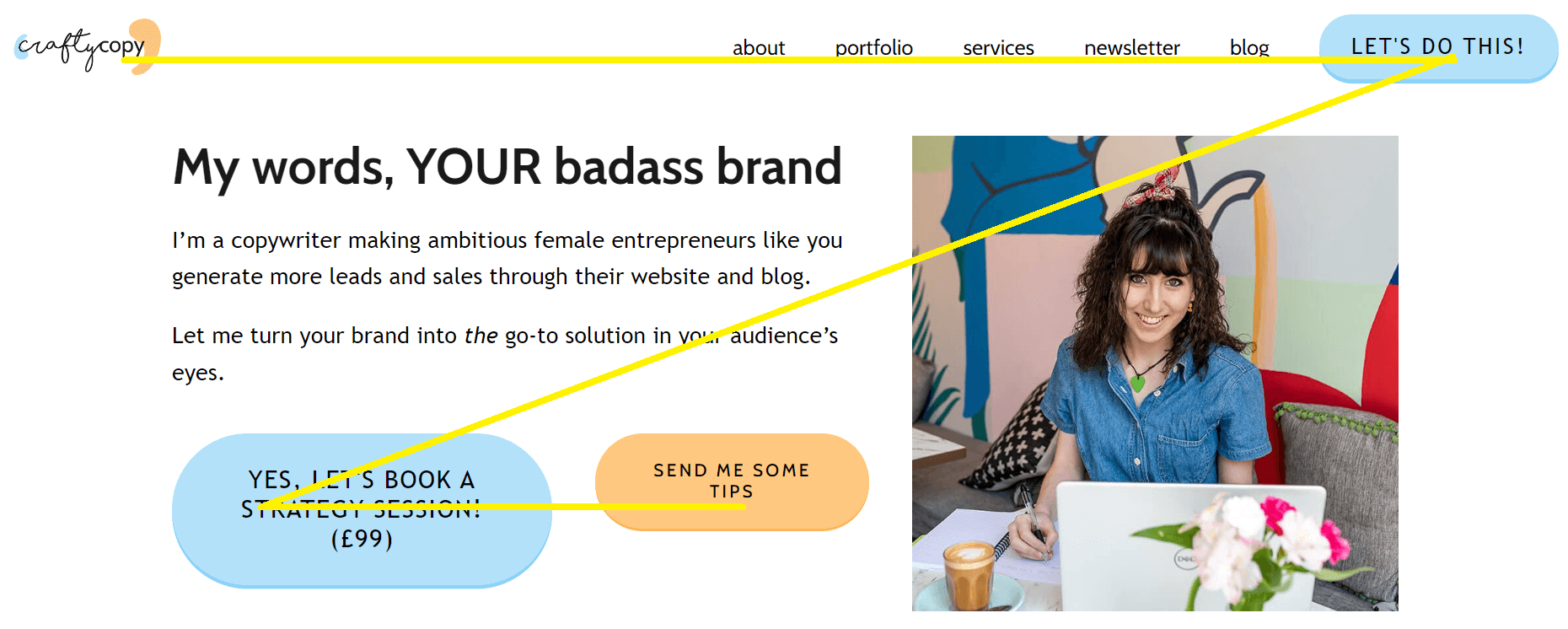
The Z-pattern is a design that follows the natural route travelled by human eyes when reading: left to right and top to bottom.
Basically, it consists of three parts:
Your eyes will start from the top left of a page and move towards the top right (horizontal line)
Then, they’ll move back to the left side of the page but a bit lower (diagonal line from the top right to the bottom left)
Finally, they’ll repeat the first step (another horizontal line)
If you put these three imaginary lines together, you get a z-shape.
By planning your web design and copy accordingly, you’ll create a smoother flow for your visitors’ eyes, facilitating readability instead of putting them off.
Mind you: the Z-pattern design doesn’t have to be perfectly symmetrical.
In fact, it can include different angles as long as the final result resembles this zig-zaggy letter.
And don’t worry: the website Z-pattern layout is actually much easier to spot once you’ve actually seen one rather than just read an explanation.
While we’ll look at more examples soon, here’s a quick one from my own homepage:
Much clearer, right?
Why is the Z-pattern important?
The Z-pattern layout is important when it comes to websites because it facilitates the reading side of things for your visitors, getting them to focus on exactly what you want them to focus on the most.
This pattern is also what immediately draws their eyes towards your call-to-action buttons rather than the privacy page. Your unique proposition before the explanatory copy.
You get the gist, right?
Ok, but what has the Z-pattern design got to do with website copy, Giada?
Well, the Z-pattern layout per see is worthless if, as well as relevant graphic elements, it doesn’t include copy that will convince the reader to stick around and complete an action!

Just because this pattern helps them focus on the right page items, it won’t work wonders if they feature poorly crafted words like “We pride ourselves in our business solutions”
At the same time, if you have the perfect words for your target audience but they’re scattered all over the place, they won’t be as effective as they could be
Basically, your Z-pattern design and website copy should work together to maximise conversions.
F- and Z-patterns in context
The Z reading pattern layout isn’t the only option. In fact, while it’s the best one in certain cases, you might want to choose the F-pattern in some others.
What the F is an F-pattern?
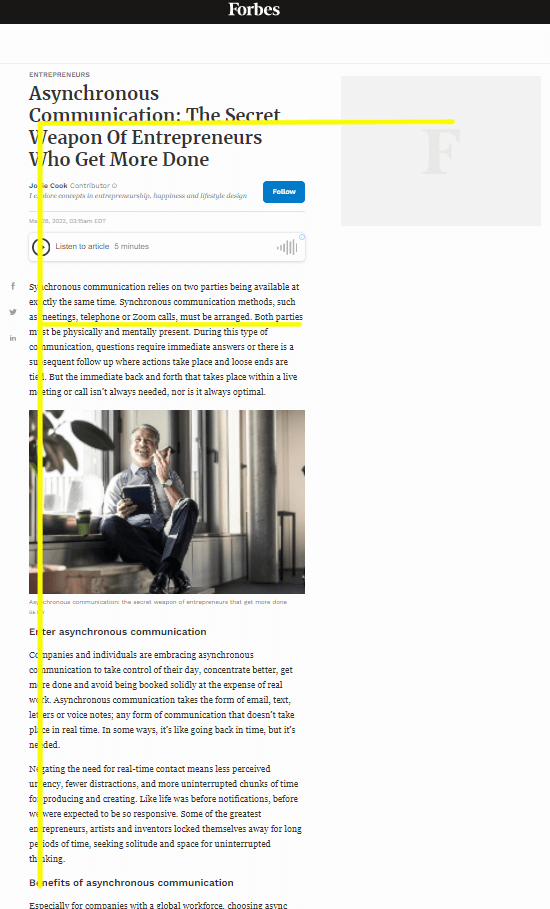
The F-pattern is the most common way in which people scan larger blocks of content: from left to right, but focusing on the first sentences more and then skim reading the rest.
When it comes to harnessing it on your website, the F-pattern layout involves placing the most important information on top and facilitating readability by having shorter sentences or bullet points on the left towards the bottom.
Here’s an example of the F-pattern:
So, when should you use the F-pattern and Z-patterns on your business website?
The F- and Z-patterns are both extremely effective… but only when used right!

The F-pattern is better suited for longer pages and blocks of texts, such as blog posts
The Z-pattern works on pages with less text and that must focus on grabbing someone’s attention immediately instead of overwhelming them with information, such as Home pages and post-click landing pages
More specifically? The website Z-pattern layout is key in the above-the-fold section on these pages.
If you’re not familiar with this term, it’s nothing complicated: it simply refers to everything that your visitors can see before they scroll down.
When they open a new page, that’s what will ultimately make or break the deal, because... if it doesn’t convince them to scroll down, they’ll leave.
In most cases, combining excellent short copy with the Z reading pattern layout is your best chance to capture your audience’s attention immediately.
Effective website Z-pattern examples (and a terrible one without it)
Here are a few more screenshots to show you this pattern in action and help you recognise it even when you haven’t got the luxury of finding my little yellow lines.

We immediately focus on the time-sensitive offer and move our eyes towards the CTA button on the right
We see Hello Fresh’s USP in the middle
As well as noticing some mouthwatering food on the left, we end up looking at the other CTA button

In this Z-pattern example, a strong question grabs our attention right from the start
We find out more about what this marketer can do for us
We’re given a clear and unmissable CTA
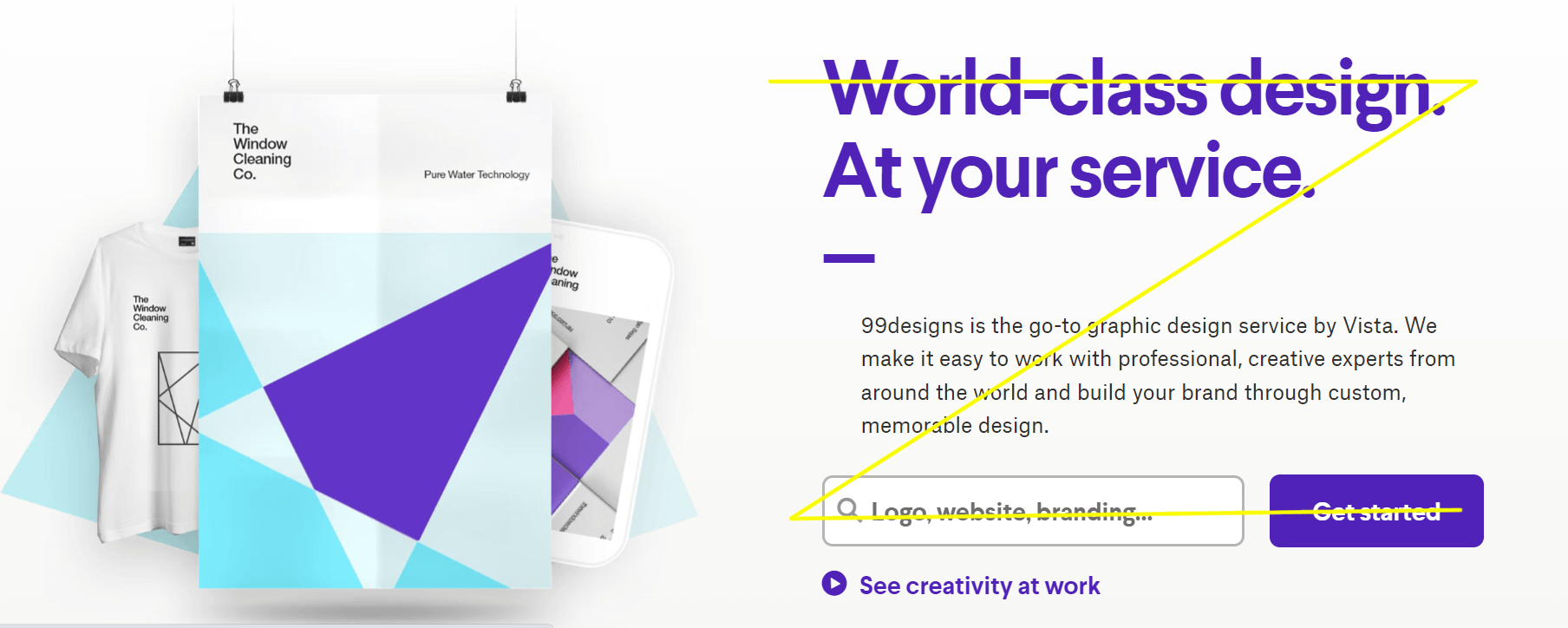
This is an example of how a Z-pattern design doesn’t automatically have to take up the entire width of your web page:
We read a short sentence that grabs our attention…
… move on to this platform’s USP…
… and see an unmissable CTA button
Now, let’s be honest: sometimes we don’t realise how important something is until we lose it, like Ross with Rachel in Friends.
So, here’s what happens when you create a Home page that does NOT harness the Z reading pattern:
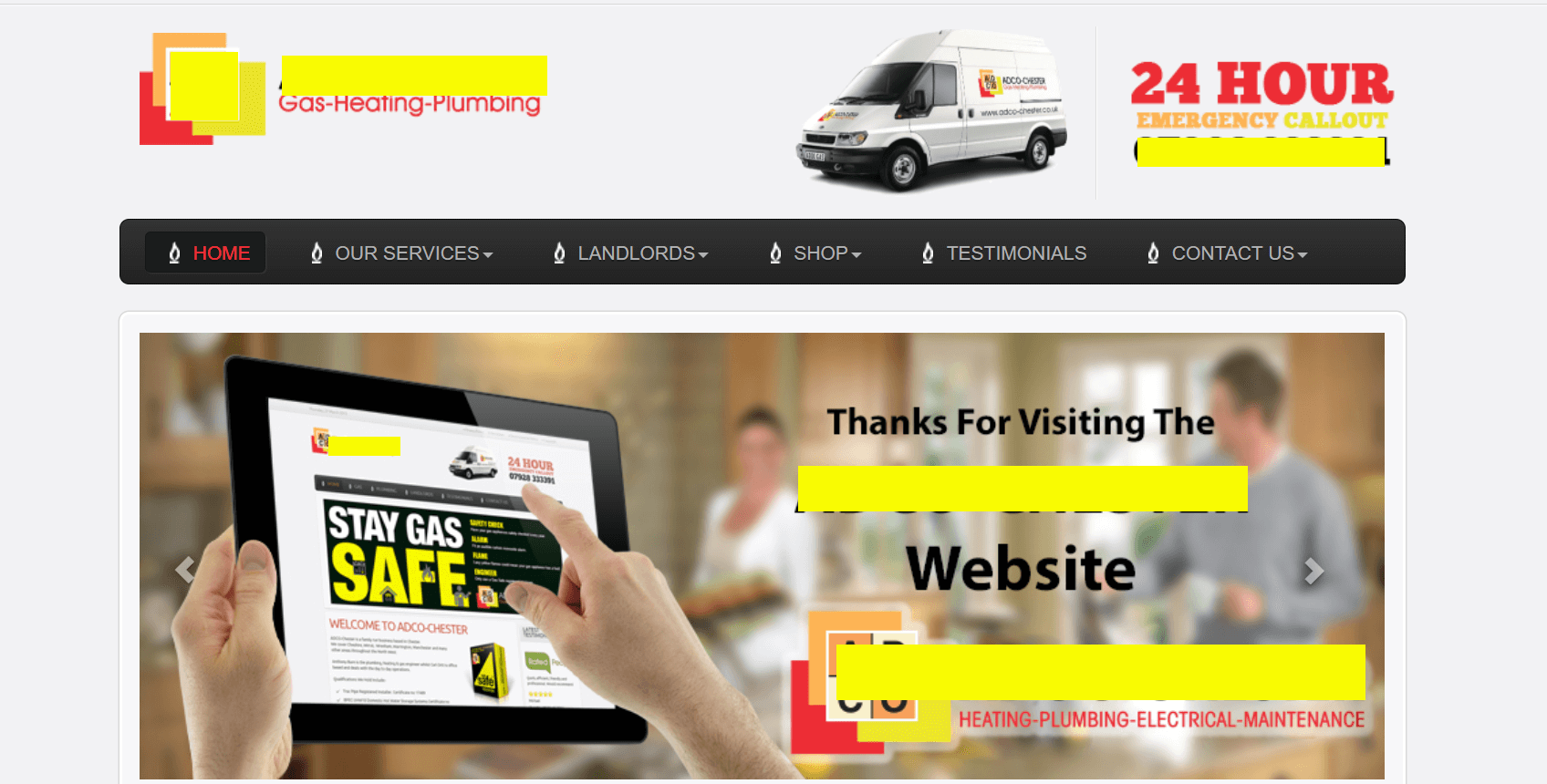
Confusing, right?
Our eyes just don’t know on what we should focus:
The van is quite distracting
Then we see a tablet with a page that looks… just like this actual page
For some reason, we’re being thanked for visiting this page instead of being told what this company can do for us…
… and we’re not given a clear CTA once our eyes get to the bottom right section
Don’t make the same mistake!
How to create an effective z-pattern on your Home and landing pages
So, now that you’ve seen how clean it looks and the difference it makes when it comes to conversions, how do you implement the Z-pattern layout on your own business website?
Here are its three core steps.
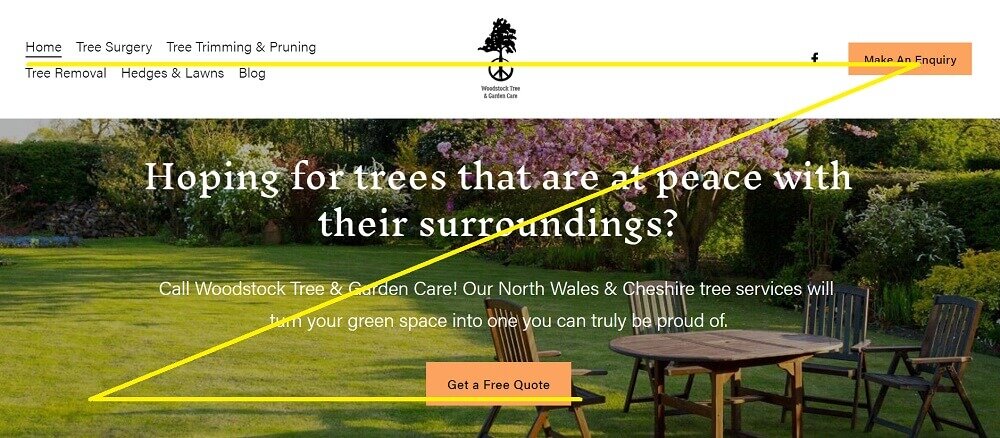
Sample of the z-pattern layout on one of my clients’ websites (all words by yours truly)
1. Top horizontal line
For the best results, I recommend placing:
Your logo on the top left, if you can: because that’s where your visitors’ eyes will start their journey, this will help you improve brand recognition
Then, your main navigational menu
At the top right, it’s helpful to have your call to action in a different colour/style from the rest of your menu items: that spot is the equivalent of some extremely precious real estate, so you don’t want to waste it!
Alternatively, depending on your website’s layout, the top horizontal line could consist of a large, attention-grabbing headline.
2. Diagonal line
Here’s where all the build-up towards your call-to-action should happen.
The one or two sentences that immediately convey what you do, who for, and how this benefits them.
3. Bottom horizontal line
That’s the hot spot for your call-to-action!
Depending on the layout of your website, the bottom line of your Z-shape might include some additional explainer copy after your main headline, too.
Still, you can’t forget about the call-to-action: place it towards the bottom right side, right at the end of the second horizontal line.
Now that you know what it looks like, I bet you’ll start seeing this pattern everywhere!
And it’s not a coincidence: that’s simply because implementing the Z-pattern layout is highly fruitful when it comes to convincing your new visitors to stick around and generate conversions.
Need some effective website copy that takes the Z-pattern into account (amongst… a ton of other tricks)? 🔥
Not to sound dramatic, but… after learning the difference that something as (seemingly) trivial as a Z-pattern design can make on your business website, how much are you STILL missing out on?
From clarity to powerful CTAs, your website copy can either confuse your prospects and push them away or impress them, get them to stick around, and convert them into leads and sales.
As a website copywiter & brand messaging consultant, I specialise in writing copy that turns ambitious female entrepreneurs into THE go-to solution in their dream audience’s eyes.

If there was no actual strategy behind the words on your business website, let’s replace them with some audience-oriented and SEO-friendly copy that sets you up for success.
As well as taking the Z-pattern layout into consideration whenever relevant, I’m always more than happy to work with your web designer or existing wireframes.
And, if you haven’t got any just yet, that’s cool: I can create some UX-focused wireframes for your new copy, too.
More #crafty blog posts on this topic